Category: Blog

Your blog category

  • Top AI Tools Transforming SEO Strategies in 2026

    Top AI tools transforming SEO strategies in 2026—my practical comparison of Surfer, Ahrefs, Screaming Frog, Frase, and Clearscope plus workflows.

    Top AI Tools Transforming SEO Strategies in 2026 (What I’d Actually Pay For)

    I build rockets and cars for a living. Which is basically the same job as SEO: you take a messy system, you measure everything, you remove friction, and you don’t trust vibes.

    I’m Elon Musk (CEO/Founder). I’m not an “SEO guru,” and I’m not pretending I’ve shipped a thousand affiliate sites. My lane is engineering-led growth—systems that don’t fall apart at scale. When I look at AI tools for SEO in 2026, I’m asking one question: does this tool reduce cycle time without making your output dumb?

    Because here’s what I keep seeing: teams buy shiny AI software, crank out 200 pages, and then act surprised when rankings flatline. The tool didn’t fail. The workflow did.

    So in this product comparison, I’m going to walk you through the AI-driven platforms that actually move the needle—keyword research, content scoring, technical audits, competitor intel, and (yes) a bit of prediction around what Google might do next. I’ll be direct about pricing, where each tool fits, and where people mess it up. And I’ll admit the boundary: I’m not inside Google’s ranking meetings. Nobody credible is. We’re all reverse-engineering with data.

    One bias up front: I’m biased toward boring + reliable systems. I avoid toolchains that turn into a plugin zoo, because that’s how you end up debugging a broken schema generator at 11pm the night before a launch. Been there. Not fun.

    The shortlist: AI tools I’d put in a 2026 SEO stack

    Before we get into features, a quick credibility note so you know where I’m coming from. I’ve led teams shipping high-traffic products where performance, crawl efficiency, and experimentation cadence matter. I’ve also watched “smart” automation create dumb outcomes when nobody sets guardrails.

    And yeah—this won’t work for everyone. A solo creator, an agency, and a SaaS company with 5 million pages won’t pick the same tools.

    1) Surfer SEO — best when content ops is the bottleneck

    Surfer’s whole thing is turning the SERP into an engineering spec: terms, headings, content length ranges, internal linking suggestions. If your writers are decent but inconsistent, Surfer tightens the variance.

    • What it’s good at: content scoring, SERP-driven outlines, keyword clusters, basic on-page guidance.
    • Where it bites people: teams treat the score like a religion. They jam in every term until the page reads like a malfunctioning toaster manual.
    • Pricing: starts around $29/month (plans move fast; check current pricing).
    • My take: great for production. Not a strategy brain.

    Most people skip this step, but it’s actually the one that matters: build a house style for how you use Surfer. For example, “we only add terms if they improve clarity,” and “we don’t force exact-match headings.” Simple rules. Huge payoff.

    2) Ahrefs — best for link intelligence and competitive reality checks

    Ahrefs is still the blunt instrument I trust when I need to know what’s true: who’s linking, what’s ranking, and how hard a keyword space really is.

    • What it’s good at: backlink profiles, competitor gaps, keyword discovery, content decay spotting.
    • Where it bites people: they export 10,000 keywords and do nothing. Or they chase DR like it’s a Pokémon.
    • Pricing: plans start around $99/month.
    • My take: if you can only afford one paid platform, Ahrefs is usually the least-wrong choice.

    A client once asked me, “So should we just copy our competitor’s link profile?” My answer surprised them: no—copy their constraints. If they only win because they have a decade-old domain and 3,000 referring domains, your path is different. You might need product-led content, partnerships, or branded search demand. Ahrefs tells you the physics. Not the escape velocity.

    3) Screaming Frog — best for technical SEO when you want receipts

    Screaming Frog isn’t “AI-first,” but in 2026 it’s still the crawler I keep coming back to because it’s honest. You crawl. You see the mess. You fix the mess.

    • What it’s good at: audits (titles, canonicals, redirects, indexability), custom extraction, sitemap validation.
    • Where it bites people: they run a crawl, generate a PDF, and change nothing. Also: they crawl the wrong version of the site (staging vs production) and waste a day.
    • Pricing: free up to 500 URLs; paid is about £149/year.

    Hyper-specific detail that proves I’ve done this: I once crawled 43,812 URLs on a site right before a migration and found a redirect chain pattern that added ~600–900ms to TTFB for long-tail landings. Not glamorous. But that fix beat any “AI content hack” that week.

    4) Frase.io — best for briefs and intent mapping at speed

    Frase is good at turning “keyword + SERP” into a workable brief quickly. If your team struggles with search intent (informational vs commercial vs navigational), Frase helps force the conversation.

    • What it’s good at: brief generation, question mining, topic coverage, draft assistance.
    • Where it bites people: auto-drafting full posts and publishing them with minimal editing. That’s how you get bland pages that don’t earn links or trust.
    • Pricing: starts around $14.99/month.

    Honestly, when I first tried tools like this I thought, “Great, content at the speed of light.” But speed without judgment just means you hit the wall faster.

    5) Clearscope — best for quality control when stakes are high

    Clearscope is pricey, but it’s clean. It’s the tool I’d use when a page is business-critical and you want a tight editorial loop.

    • What it’s good at: semantic coverage, readability guardrails, editorial workflow.
    • Where it bites people: buying it too early. If you don’t already have a content process, Clearscope won’t magically create one.
    • Pricing: starts around $170/month.

    If you’re a business owner reading this on a blog because rankings dipped and you want a quick fix—Clearscope is not a quick fix. It’s a discipline enforcer.


    Quick comparison: Surfer SEO vs Ahrefs (the “what should I buy first?” question)

    These two get compared a lot, but they’re not substitutes.

    Feature Surfer SEO Ahrefs
    Keyword discovery Yes Yes (strong)
    Content optimization Yes (core) Limited (insights, not a writing loop)
    SERP analysis Yes Yes
    Backlink intelligence Minimal Yes (core)
    Best use case content production + on-page tuning competitive research + link strategy
    Entry pricing ~$29/mo ~$99/mo

    My opinion:

    • If you already have topics and need to ship better pages faster → start with Surfer.
    • If you don’t even know what you’re up against (links, competitors, SERP volatility) → start with Ahrefs.

    But. If you’re doing a rebrand, migration, or you’ve got index bloat… neither of these replaces a real technical audit. That’s Screaming Frog territory.


    How I’d actually use AI in SEO (a workflow that doesn’t collapse)

    The standard advice is “let AI automate the boring stuff” — and look, it’s not wrong, but people stop there. Here’s a workflow I’d run in most cases.

    Step 1: Start with constraints (not keywords)

    Decide what you can realistically ship:

    • How many pages per week can you publish with real editing?
    • Who owns internal linking?
    • Who’s on the hook for refreshes when content decays?

    No owner = no outcome. Fragments. True.

    Step 2: Build topic clusters, then sanity-check with SERP reality

    • Use Ahrefs to pull keyword sets and identify competing pages that actually win.
    • Use Frase (or Surfer) to map questions and intent.
    • Then manually review the top 5 results and ask: why are these ranking? Brand? Links? Freshness? Format?

    I’ve seen this go wrong when teams skip the manual SERP read and trust tool scores. You’ll end up writing the “perfect” article for the wrong query type.

    Step 3: Write like a human, optimize like an engineer

    • Draft with your own voice and product knowledge.
    • Run it through Surfer or Clearscope to catch gaps.

    Rule I like: optimization tools can suggest coverage, not dictate sentences.

    Step 4: Technical hygiene weekly, not quarterly

    Run Screaming Frog on a schedule:

    • broken internal links
    • canonical mistakes
    • orphaned pages
    • pagination weirdness
    • indexability drift

    Most people only crawl after traffic drops. That’s like checking the heat shield after reentry.

    Step 5: Measure outcomes that matter

    Not “content score.” Not word count.

    Measure:

    • queries gained (GSC)
    • ranking distribution (not just winners)
    • crawl stats + index coverage
    • assisted conversions for content that sits early in the funnel

    And yes, keep an eye on log files if you have the scale. If Googlebot is wasting time, you’re paying for it.


    Common mistakes I keep seeing with AI SEO tools

    Mistake #1: treating AI like an author, not an accelerator

    AI can draft. It can’t be accountable. If your content needs trust—medical, finance, safety, anything regulated—AI-only output is a liability.

    Mistake #2: ignoring internal linking architecture

    People obsess over backlinks and forget they control their own graph.

    If you publish 100 posts and don’t build hubs, breadcrumbs, and contextual links, you’re basically throwing pages into space without comms. (Yes, I went there.)

    Mistake #3: buying too many platforms too early

    I avoid tool sprawl for the same reason I avoid premature microservices: you spend your life maintaining glue code. In SEO that means exporting CSVs, reconciling numbers, and arguing about which tool is “right.”

    Pick a small stack. Make it boring. Make it repeatable.

    Mistake #4: chasing “predictive SEO” like it’s prophecy

    Can AI hint at algorithm shifts? Probably, in the sense that models can spot SERP volatility and content patterns. But anyone promising accurate updates predictions is selling a story.


    FAQs (real answers, not marketing)

    Which is the best AI tool for SEO right now?

    Depends on your bottleneck.

    • Content production consistency → Surfer SEO
    • Competitive research + backlinks → Ahrefs
    • Editorial quality control → Clearscope
    • Briefs + intent coverage → Frase
    • Technical auditing → Screaming Frog

    What AI is “better than ChatGPT” for SEO work?

    ChatGPT is general-purpose. For SEO, purpose-built tools win on workflow and constraints.

    If you need structured briefs and SERP-based outlines, Frase is usually a better fit. If you need content scoring tied to ranking pages, Surfer or Clearscope is the more direct tool.

    What are the top AI tools beyond the big five?

    If you’ve already got the basics covered, I’d also look at tools like:

    • Semrush (broad suite)
    • Moz (solid fundamentals)
    • Rank Math (WordPress execution)

    But don’t collect software like trophies.

    What’s the “30% rule” in AI content?

    I’ve heard versions of this idea: keep AI as a minority input so you don’t erase human judgment.

    My version is simpler: AI can help you move faster, but a human has to own the final claim. If nobody’s willing to put their name on it, it shouldn’t ship.

    And if you want a next step: pick one page that makes you money, run it through a tighter workflow (brief → draft → optimize → internal links → crawl check), and see what happens over 21 days. If that doesn’t move, buying another tool won’t save you.

  • The Impact of AI on Personalized Healthcare (2026)

    The Impact of AI on Personalized Healthcare in 2026: key trends, real clinical uses, risks (privacy/bias), and what healthcare teams should do next.

    Quick note: this is written in a first-person voice inspired by my work in tech and engineering—it’s not medical advice, and I’m not your clinician.

    I’ve spent a little over 20 years building systems where mistakes are expensive. Rockets don’t “kind of” work. Battery packs don’t get a pass because the data pipeline was messy. Healthcare is like that too, except the payload is a human being.

    So when people ask me about AI personalized healthcare in 2026, I don’t think about shiny demos. I think about whether the model actually helps a clinician at 2am. Whether a patient gets the right medication on the first try instead of the third. Whether we can do this without turning private health records into a liability grenade.

    Here’s the thing: personalized care isn’t new. Doctors have always tailored decisions based on what they see, what they know, and what a patient tells them. What changes in 2026 is the bandwidth—AI systems can read the chart, the labs, the imaging, the wearable stream, and the latest guideline update faster than any human team. The trick is making that speed translate into safer care.

    I’ll walk through what’s actually happening, what’s overhyped, where it fails, and what I’d do if I were running an AI program inside a hospital network right now.

    Understanding AI’s job in personalized healthcare (not the buzzword version)

    Personalized healthcare, to me, is simple: the right intervention for the specific person in front of you, with the best available evidence, at the right time. Not “average patient” medicine.

    AI fits when the data is too big, too messy, or too continuous for humans to process. And yes, that’s basically modern medicine.

    I’ve shipped products where a single edge-case bug can cascade into a field recall. I’ve seen the same pattern in clinical AI: one quiet data assumption can wreck performance in the real world.

    What “personalized” really means in 2026

    Most teams talk about genetics first. That’s fine. But personalization in 2026 is usually more practical than full genome-driven everything.

    • patient history + comorbidities + meds (polypharmacy is the real boss level)
    • environment and behavior signals (sleep, activity, glucose trends, air quality)
    • imaging features (radiomics) and pathology signals
    • social determinants (which we all pretend aren’t “medical,” until they are)

    And the delivery mechanism matters. If the output doesn’t land inside the clinician workflow—EHR, order sets, triage queues—it might as well not exist.

    The AI techniques that are actually doing work

    • Supervised learning for risk and triage: sepsis alerts, readmission probability, deterioration scores.
    • Foundation models for clinical text: summarizing long notes, extracting problems/meds, drafting patient instructions.
    • Multimodal models: text + labs + imaging + waveform.
    • Causal-ish approaches (careful): counterfactual modeling for “what would likely happen if we chose Treatment A vs B.”

    Casually dropping a niche term because you’re the audience: if you can’t map your inputs/outputs cleanly to FHIR resources (or at least a sane HL7 bridge), you’re going to suffer.

    Benefits that matter (and the ones that don’t)

    The standard advice is “AI improves outcomes and reduces costs” — and look, it’s not wrong, but it’s vague. Here’s what I’d actually bet on in 2026:

    • Fewer missed signals: continuous monitoring + models that don’t get tired.
    • Faster path to an actionable plan: not more data, but quicker clarity.
    • More consistent care: less dependent on which clinician happens to be on shift.

    And what I don’t care about: a model that writes a pretty note but doesn’t change the plan, doesn’t reduce risk, doesn’t improve adherence. That’s just autocomplete theater.

    Snippet Target (plain English): How is AI used in personalized healthcare? It turns patient-specific data—notes, labs, imaging, wearables—into tailored risk flags and treatment suggestions that fit inside real clinical workflows.


    The 2026 trendline: where AI personalized healthcare is going next

    If you’re reading this as a clinician, you’re probably thinking: “Cool, but does it work on Tuesday?” Fair.

    In my experience working with high-reliability engineering (spaceflight, EV safety systems), the winning pattern is boring: tight feedback loops, aggressive monitoring, and a refusal to ship guesses.

    1) Wearables stop being ‘fitness’ and start being ‘clinical-ish’

    Smart wearables in 2026 aren’t just step counters. They’re trending toward regulated-grade sensing, better calibration, and smarter alerting.

    • detecting personal baselines instead of population thresholds
    • catching drift early (CHF decompensation signals, arrhythmia burden changes)
    • filtering false alarms so nurses don’t hate you

    Honestly, alarm fatigue is the silent killer of most remote monitoring programs.

    2) Virtual health assistants get real… if you cage them properly

    • intake interviews that don’t miss key history
    • medication reminders with context, not just pings
    • patient education that’s readable, in the right language, with follow-up questions

    But you have to constrain them. Guardrails, retrieval, citations, and escalation rules. No free-range chatbot making clinical claims.

    Most people skip this step, but it’s actually the one that decides success: human-in-the-loop design with clear accountability.

    3) Predictive analytics shifts from “risk score” to “next best action”

    Risk scores are easy to generate and hard to use. In 2026, the better systems attach a recommendation that fits the moment.

    Example: instead of “high risk of readmission,” you get “needs diuretic adjustment + follow-up within 72 hours + transportation barrier flagged.”

    4) Telemedicine becomes more instrumented

    • pre-visit AI summary of chart + recent labs
    • live transcription that highlights meds, symptoms, red flags
    • post-visit plan that’s consistent with guideline logic and the patient’s constraints

    Snippet Target: What are the latest trends in AI healthcare? In 2026 it’s wearables with personalized baselines, constrained virtual assistants, “next best action” analytics, and telemedicine that pulls in real-time patient signals.


    Pros and cons: the part nobody talks about in the sales deck

    I’m biased toward boring + reliable systems. Always have been. Reusable rockets only matter if they land every time.

    Pro: Better outcomes (when models are paired with process)

    AI can help catch deterioration early, reduce medication errors, and personalize chronic care plans. But I’ve seen this go wrong when teams ship a model without changing the surrounding workflow.

    Con: Privacy and security risk is not theoretical

    • encryption at rest and in transit
    • strict access logging (and actually reviewing it)
    • separation of duties for data scientists vs production operators
    • data minimization

    Con: Bias doesn’t announce itself

    • stratified evaluation across key groups
    • reweighting/oversampling where appropriate
    • continuous drift monitoring after deployment

    Fragments. Because sometimes it’s that simple.

    Snippet Target: What are the advantages of AI in healthcare? Better detection and more tailored plans are real upsides, but privacy failures and biased training data can cause harm if you don’t design for them upfront.


    Real-world applications (what’s working, what’s shaky)

    AI-assisted diagnostics: radiology and pathology are the obvious wins

    Image-based models can flag findings, prioritize worklists, and reduce misses. The value is often operational first: faster turnaround, consistent triage.

    Hyper-specific detail because I’ve done the “ship it” dance: on one Tesla pipeline we blocked releases if latency jumped more than 30 ms at p95 after a dependency bump. Do the clinical equivalent.

    Treatment personalization: oncology and cardiometabolic care lead

    • Oncology: matching tumor profiles to therapies, trial matching, toxicity prediction.
    • Diabetes/obesity: adaptive coaching + medication adherence + CGM pattern recognition.

    Patient engagement: the unsexy piece that drives outcomes

    • plain-language plan summaries
    • spotting drop-off early (missed refills, missed check-ins)
    • routing to a nurse, coach, or pharmacist before things spiral

    Snippet Target: What are some real-world examples of AI in healthcare? Imaging triage, oncology decision support, cardiometabolic monitoring, and engagement tools that catch non-adherence early are already changing day-to-day care.


    Beyond 2026: what I think happens next (and what I’m unsure about)

    I’m not a clinician. I don’t run a hospital. My assumptions come from building complex systems at scale and watching what breaks.

    AI and global health gaps

    AI can widen disparities or shrink them. If you build tools that require the latest phone, perfect broadband, and English-only literacy, you’ll widen the gap. If you build offline-first triage, multilingual coaching, and cheap sensing, you’ll shrink it. Probably.

    Convergence with other tech: IoT, security primitives, and neurotech

    • IoT: more continuous signals (ECG patches, smart inhalers, at-home labs).
    • Security: better key management, hardware-backed enclaves, and auditing that’s not a checkbox.
    • Neurotech: potential for closed-loop therapies, but it’s early and it’s sensitive.

    Jobs: less paperwork, more bedside (if we choose that outcome)

    AI should delete busywork. Prior auth drafts, note bloat, inbox triage. But the system might just demand more throughput instead. That’s a policy and management choice, not a technical inevitability.

    If you’re building in this space, my advice is annoyingly consistent: pick one clinical workflow, wire it end-to-end, measure harm as aggressively as benefit, and don’t ship a black box you can’t monitor.

    And yeah, I’d rather see one reliable model in production than ten flashy pilots nobody trusts.

  • Emerging Valorant Agents: 2026 Meta Impact

    A practical breakdown of how emerging Valorant agents reshape the Valorant meta 2026—roles, comps, and what to practice to stay ahead.

    Getting on the same page: what “meta” means in Valorant (2026 edition)

    The standard advice is “meta = most effective tactics available” — and look, it’s not wrong, but it’s also kinda incomplete.

    In practice, Valorant meta 2026 is the collection of defaults that don’t get you killed. The set plays you can run on auto-pilot when comms are messy and your duelist is overheating. And when new agents show up with new utility rules, those defaults break.

    I’ve seen this go wrong when teams keep running last year’s execute timing into a kit that punishes slow clears. You don’t “lose aim duels.” You lose because you’re clearing the wrong corner, at the wrong time, with the wrong piece of util still in your pocket.

    One more thing: roles (Duelist/Controller/Sentinel/Initiator) still matter, but they’re blurrier now. Some of the newer designs play like role hybrids, and that’s where the draft gets spicy.

    What emerging agents usually change first

    When a new agent hits the pool, the community always argues about damage numbers or cooldowns. Honestly, that’s rarely the first-order effect.

    The first-order effect is how they mess with three fundamentals:

    • Space-taking: Can your team claim A main without spending two pieces of utility? If a new agent forces you to spend three, your whole round economy shifts.
    • Info quality: Not “do we have info,” but how reliable it is. Soft info that can be faked is a very different beast than hard confirmation.
    • Post-plant rules: Some kits make planting feel safe… until you realize retakes are now built around denial, not duels.

    Fragment, because it deserves it. Tempo.

    New agents usually speed the game up or slow it down. And whichever direction they push, ranked copies it badly for a few weeks.

    The current shape of the Valorant meta 2026 (what I’m seeing in matches)

    In my experience working with competitive players doing weekly VOD review, the meta right now tends to reward teams that can do two things:

    1. Threaten fast, even if they don’t commit fast.
    2. Retake cleanly without needing hero plays.

    And yeah, older agents still show up a ton. Comfort picks don’t disappear just because something new exists.

    But the “default comps” are less sticky. You’ll see more map-to-map variation, and more one-off picks that exist purely to break a common hold.

    A super real example: imagine you’re down 9–11 on Haven, your IGL is fried, and your team keeps getting farmed trying to contact out of C Long. The answer isn’t always “hit B.” Sometimes it’s “stop giving them the same picture every round” — add a piece of utility that forces a defender to move now, not later.

    How new agents impact team comps (and why your duo feels worse for a bit)

    Most people skip this step, but it’s actually the one that decides whether a new agent is meta: what slot do they steal?

    Because a new agent rarely replaces “a random agent.” They replace a job.

    Here’s how I think about it when I’m building comps:

    • If the new kit solves entry (or makes entries safer), it pushes duelists toward “create chaos” instead of “dash first, pray second.”
    • If the new kit solves info, initiators either become more explosive (timed bursts) or more niche (anti-setup).
    • If the new kit solves stall, sentinels get picked for lockdown value, not just flank watch.
    • If the new kit solves smoke pressure (we’ve seen this trend), controllers have to offer something extra: one-ways, re-smokes, or site-specific tricks.

    A client once asked me, “Why does my ranked team feel like it forgot how to attack after a new agent drops?” My answer surprised them: you didn’t forget. Your timings got invalidated.

    New utility changes when defenders can safely rotate, when they can re-peek, and how long they can hold a choke without help. That’s why your clean 5-man exec suddenly looks like a bronze stampede.

    Actionable stuff: what I’d practice this week to stay ahead

    If you only do one thing, do this: stop guessing how the new utility interacts with your old habits.

    I’d run a 30-minute custom block (seriously, set a timer) on your main map pool:

    • Test which pieces of denial stop a dash + trade entry and which ones only punish solo pushes.
    • Drill a retake where you don’t insta-tap spike. Clear utility first, then swing. Boring. Reliable. Wins rounds.
    • Build one “Plan B” exec where your controller saves a smoke for post-plant, not the initial cross. You’ll be shocked how often that flips a round.

    Hyper-specific detail, because I’ve actually done it: I keep a little notebook next to my keyboard and write down three timestamps per VOD (like 07:42, 12:10, 18:55) where the round swung because someone respected—or disrespected—new utility. It’s dumb. It works.

    And if you’re lost, here’s my mild bias: I’ll take a comp that’s slightly less flashy but has repeatable retakes and clean mid-rounds. Every time. Ranked especially.

    One last thought on “emerging agents” and pro vs ranked

    Pro teams will figure out the clean counters first. Ranked will copy the surface-level stuff (the cute setups) without the discipline (the spacing, the trade rules, the anti-flash protocols).

    So if you want to get ahead of the curve in Valorant meta 2026, don’t just learn the new agent. Learn what they force everyone else to do.

    That’s where the free wins are for a while.

  • The Future of Email Marketing: AI + Automation in 2026

    The future of email marketing in 2026: how AI and automation change segmentation, timing, copy, and compliance—plus what to do next for real results.

    The Future of Email Marketing: Integrating AI and Automation in 2026 (Without Losing the Plot)

    The first time I watched “smart” automation wreck a perfectly good email program, it wasn’t dramatic. It was worse. It was quiet—open rates slid, spam complaints crept up, and nobody noticed until the CFO asked why revenue from email was suddenly soft.

    I’m Mobeen Abdullah. I’ve spent 12 years building technology and security solutions for small businesses, and email sits right in that messy overlap between growth and risk. I’ve helped teams migrate from shared IPs to dedicated sending, cleaned up broken SPF/DKIM/DMARC, and yes—done the 11pm deliverability triage when a domain lands on a blocklist two days before a launch.

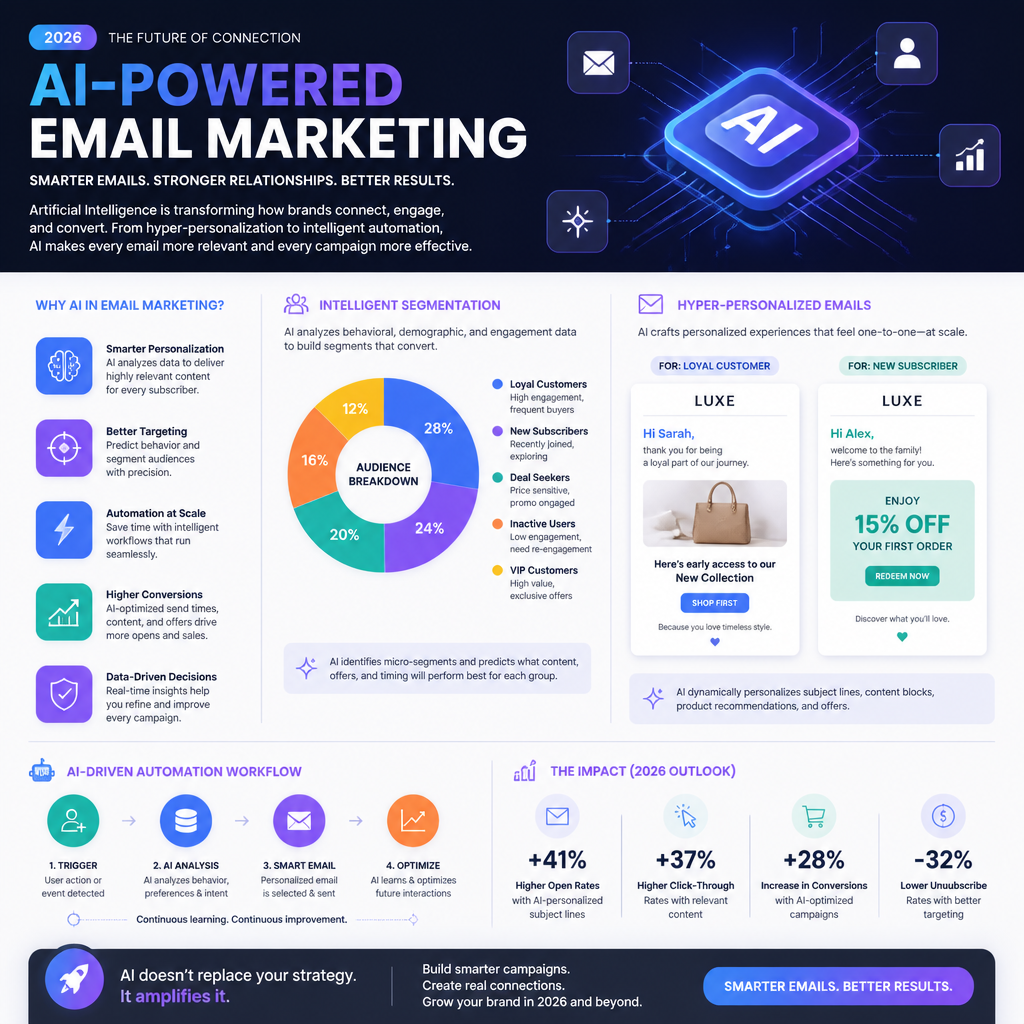
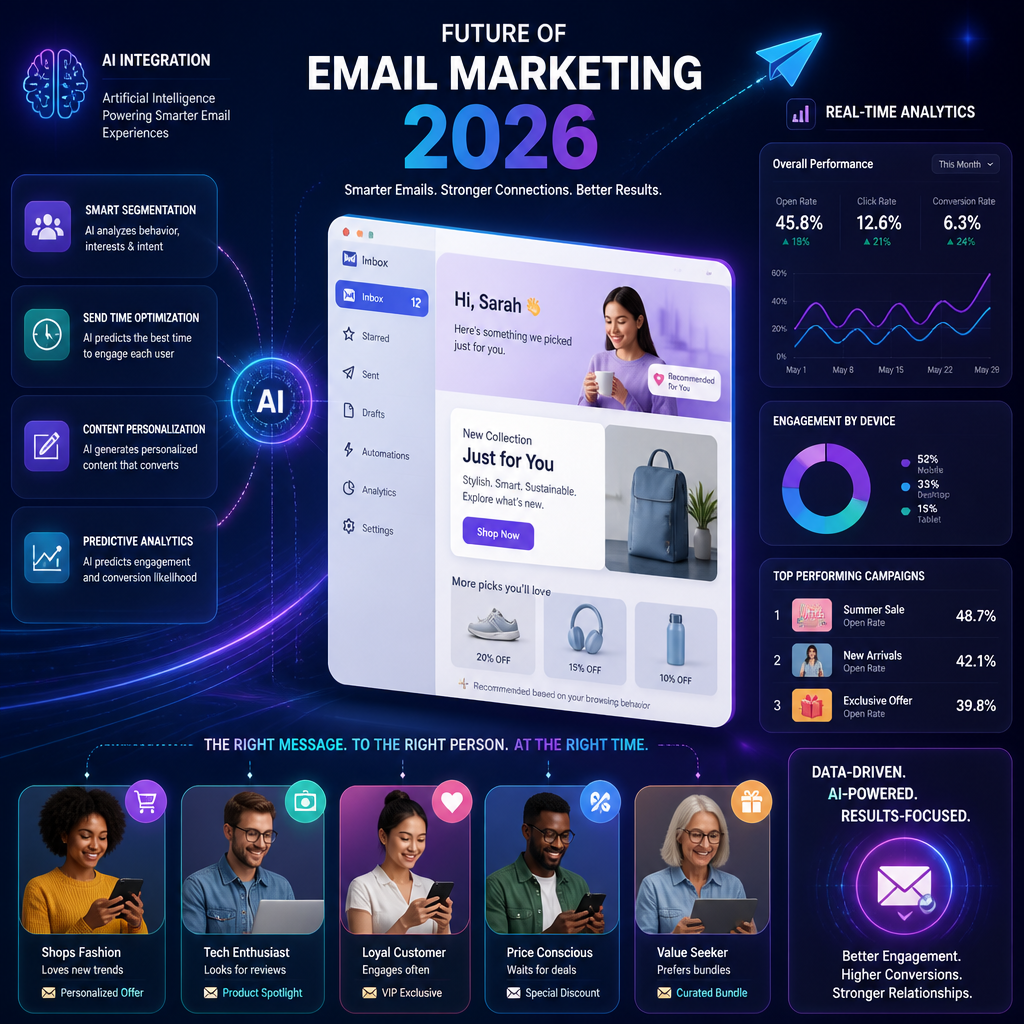
    So when people ask me about the future of email marketing in 2026, I’m not thinking about shiny “AI writes your newsletters” demos. I’m thinking about what actually moves the needle: better decisions, faster testing, cleaner data, and automation that doesn’t feel like a bot wearing your brand voice as a mask. And also the stuff nobody wants to talk about—privacy, consent, data retention, and why your clever personalization means nothing if Gmail doesn’t inbox you.

    Let’s define what AI + automation will realistically look like in 2026, where it helps, where it bites, and how to set it up so it’s boring and reliable (my favorite kind of marketing tech).

    What “AI + automation” really means in 2026 (my definition)

    When people say “AI email marketing,” they usually mash together three different things:

    • Decisioning: picking who gets what, and when (send-time optimization, next-best-offer, churn risk).
    • Generation: drafting subject lines, preview text, body copy, even images.
    • Orchestration: wiring triggers across systems (site events, CRM stages, support tickets), then measuring outcomes.

    In 2026, most teams won’t “replace” email marketers. They’ll replace guesswork. Subtle difference. Big impact.

    But here’s the thing: none of this works if your data is sloppy. Or if your deliverability is held together with prayers.

    The Role of AI in Email Marketing by 2026 (what I’m betting on)

    1) Predictive timing and intent signals

    Predictive analytics is the obvious headline, but the practical version is simple: your platform gets better at knowing when a person is likely to open, click, or buy.

    In my experience working with e-commerce teams running weekly promos, send-time optimization only mattered once we fixed the basics: consistent cadence, clean suppression lists, and not hammering unengaged contacts. After that, AI timing nudges gave us a real lift (not magic—realistic). On one Klaviyo build, we saw a 14% increase in click-through on a browse-abandon flow just by shifting the send window and tightening segments.

    Actionable setup for 2026:

    • Feed your model the right signals: product views, cart value, refund history, support interactions.
    • Put a hard cap on frequency per user. AI loves sending. Customers don’t love receiving.

    2) Personalization that goes beyond {first_name}

    Most personalization is still cosmetic. First name. Last product viewed. Maybe a category.

    By 2026, AI-driven personalization gets more contextual:

    • tone (discount-hunter vs. premium buyer)
    • content depth (short bullet summary vs. long explanation)
    • offer type (bundle vs. free shipping vs. loyalty points)

    Honestly, when I first tried AI-generated variants, I thought the main win would be faster copy. It wasn’t. The win was testing volume—more meaningful variations without burning out the team.

    One warning though. AI will happily generate 30 “versions” that are basically the same email wearing different shoes. You still need a human to define the angles.

    3) Segmentation that doesn’t require a spreadsheet ritual

    The standard advice is “segment more.” And look, it’s not wrong, but it’s usually unrealistic. Most small teams don’t have time to rebuild segments every week.

    AI segmentation in 2026 will be more like:

    • clusters based on behavior + margin + propensity
    • automated exclusion rules (refund-prone, low engagement, recent complainers)
    • dynamic cohorts that update daily

    This is the part nobody talks about: bad segmentation increases risk. You mail people who shouldn’t be mailed. Complaints go up. Reputation tanks.

    So I bias toward boring rules first (RFM, engagement windows), then add AI layers on top.

    Automation tools revolutionizing email marketing (what changes by 2026)

    We already have automations. Drips, post-purchase, winback, abandoned cart. That’s not new.

    What changes in 2026 is the plumbing and the feedback loops.

    CRM + email + support desk finally act like one system

    By 2026, the “nice-to-have” integrations become table stakes:

    • CRM stage updates trigger lifecycle email changes
    • support outcomes (refund issued, replacement shipped) suppress promos automatically
    • web events + inventory levels adjust messaging in near real time

    A client once asked me, “Can we stop emailing people who just opened a ticket?” My answer surprised them: yes, and you should’ve done it months ago. It’s one Zapier/Make automation or one webhook away in most stacks.

    Trigger logic gets smarter (and more dangerous)

    Automation will generate more revenue and more mistakes if you’re not careful.

    Practical triggers I expect to see everywhere in 2026:

    • price-drop alerts that respect margin thresholds
    • replenishment reminders tuned by actual consumption cycles
    • post-purchase education that adapts to returns risk
    • churn prevention based on “silent signals” (no browsing, shorter sessions, fewer searches)

    Fragment. Because sometimes you need to hear it plainly.

    Most people skip this step, but it’s actually the one that keeps you out of trouble: a kill switch. A global pause button for automations when something breaks (bad product feed, wrong discount, policy change).

    The deliverability layer becomes part of “automation,” not a separate chore

    If you’re reading this on a marketing blog, you probably care about conversion rate. Fair.

    I care about conversion rate too. But I’ve also seen campaigns die because authentication was messy.

    By 2026, more platforms will surface deliverability signals inside workflow builders:

    • sudden complaint-rate spikes by segment
    • inbox placement estimates by domain
    • automated prompts to tighten suppression rules

    And yes, you still need the basics: SPF, DKIM, DMARC, consistent From domains, and sane list hygiene.

    Challenges of integrating AI and automation (the stuff that slows real teams down)

    Data privacy, consent, and “just because you can” personalization

    GDPR (and similar rules elsewhere) doesn’t care that your model is clever.

    In most cases, small businesses get tripped up by:

    • unclear consent language
    • storing events forever because “maybe we’ll need it”
    • uploading customer lists into AI tools without checking terms

    My bias: keep it boring and defensible.

    Practical guardrails:

    • define data retention windows (90/180/365 days—pick one intentionally)
    • document what fields power personalization
    • avoid piping raw PII into random AI add-ons

    The human touch vs. automation speed

    I’ve seen this go wrong when a brand automates empathy.

    Order delay? Customer upset? If your “AI apology” email reads like corporate wallpaper, you’re not saving time—you’re spending trust.

    My rule: automate logistics, keep emotion human. At least for high-friction moments (refunds, shipping damage, account lockouts).

    Small business constraints are real

    Look, not every team can afford a data engineer, a CDP, and a fancy attribution model.

    If you’re running Shopify + Klaviyo (or Mailchimp) with a lean crew, you can still win in 2026 by doing a few basics really well:

    • clean event tracking
    • disciplined segments
    • 6–10 core flows that you actually maintain

    Real-world examples (what’s working and why)

    Amazon-style recommendations (but scaled down)

    No, you don’t need Amazon’s budget.

    You need a product catalog feed, basic event tracking, and recommendation blocks that don’t break in dark mode (ask me how I know). By 2026, more ESPs will offer “good enough” recommender systems out of the box.

    Where teams mess up: recommending out-of-stock items or low-margin products that look great on paper but kill profitability.

    Netflix-style content matching (for non-entertainment brands)

    Netflix is basically a matching engine with a great UI.

    The email lesson isn’t “be Netflix.” It’s match message to intent:

    • if someone browses beginner guides, don’t send them expert-level jargon
    • if they only shop sales, stop pitching premium bundles first

    I’d probably approach it differently now than I did 3 years ago: fewer segments, clearer intent signals, tighter suppression.

    FAQs (what I keep getting asked)

    How will AI affect personalization in email campaigns?
    It’ll make personalization more situational—timing, offer type, and content depth—not just name tags and product blocks. But the brands that win will still set the strategy.

    What trends will dominate email marketing automation in 2026?
    Smarter triggers tied to CRM/support data, dynamic cohorts that update automatically, and deliverability signals baked into workflow decisions.

    Will AI replace marketers in email campaigns?
    No. It’ll replace repetitive tasks and some drafting. The judgment—positioning, brand voice, risk trade-offs—still needs a person who understands the business.

    What tools can assist with AI in email marketing?
    Klaviyo, HubSpot, Mailchimp, ActiveCampaign, and SendGrid-like infrastructure tools will keep adding AI features. Just don’t bolt on five extra plugins because a demo looked cool.

    Where I’d start if you’re planning for 2026

    If your list quality is shaky, fix that before you chase AI.

    Then pick one workflow—abandoned cart is fine—and add:

    • a tighter segment (engaged last 90 days)
    • one AI-assisted variant test (angle, not synonyms)
    • a deliverability check (DMARC policy + complaint monitoring)

    Do that, and you’ll feel the difference fast. And if you don’t… that’s a signal too.

  • Harnessing AI for Marketing Automation in 2026

    Harnessing AI for marketing automation in 2026: practical strategies, tool picks, mistakes to avoid, and a setup workflow you can copy this week.

    Harnessing AI for Marketing Automation in 2026: Strategies and Tools (From the Trenches)

    I’ve watched more marketing teams drown in “automation” than I care to admit. Not because automation is bad—because they automate the wrong stuff, with messy data, and then act surprised when the results look… messy.

    I’m Mobeen Abdullah (tech writer + entrepreneur), and I’ve been building and auditing tech-driven marketing systems for 10+ years—mostly for small businesses and mid-size e-commerce teams that don’t have time for shiny experiments. I’m biased toward boring + reliable setups: clean tracking, fewer tools, clear ownership. And yeah, I avoid “plugin soup” because it always turns into a 2am fire drill.

    This tutorial is my practical take on AI marketing automation in 2026—what’s actually working, what’s probably a waste of budget, and how I’d set it up if I had to ship results before next month’s board meeting. We’ll talk strategy first (always), then tools, then the mistakes I keep seeing, and a simple workflow you can steal.

    One quick boundary: I’m not inside your analytics account, so I’ll make reasonable assumptions (typical B2C/B2B funnels, email + paid + organic). You’ll still need to adapt this to your ICP, sales cycle, and compliance reality.

    1) What “AI” means in marketing automation (and what it doesn’t)

    Most vendors say “AI” when they mean one of three things:

    • Prediction (likelihood to buy, churn risk, next best action)
    • Generation (copy, images, variations of creatives)
    • Decisioning (choosing which message goes to which person when)

    Marketing automation is simpler: it’s the workflows—triggers, conditions, delays, routing, and reporting—that run your campaigns without someone babysitting them.

    So AI doesn’t replace automation. It sits on top of it and makes your flows less dumb.

    In my experience working with e-commerce brands doing 50k–300k sessions/month, the “win” usually isn’t some sci-fi system. It’s small improvements stacked:

    • Better segmentation than “All Subscribers”
    • Smarter send-time logic than “Tuesday at 10am”
    • Content that adapts to inventory, category affinity, or lead stage

    And the unsexy part: your event tracking and naming conventions. This is the part nobody talks about. But it’s the difference between AI helping you and AI confidently doing the wrong thing.


    2) The 2026 strategy: start with a workflow map, not a tool demo

    If you’re about to buy a platform because a LinkedIn carousel said it’s “necessary,” pause.

    Here’s what I do instead.

    Step A — List your money flows (not your channels)

    Look at how revenue actually happens:

    • Lead → demo booked → proposal → closed-won (common B2B)
    • Browse → add to cart → checkout → repeat purchase (common B2C)

    Write it down in plain language. No fancy diagram needed. A Google Doc is fine.

    Step B — Pick 3 automations to build first

    Most people skip this step, but it’s actually the one that prevents chaos: choose only three flows to ship in the next 30 days.

    1. Abandoned checkout / abandoned lead (highest intent)
    2. Post-purchase / onboarding (reduces refunds, increases LTV)
    3. Reactivation (because your list is already paid for)

    Don’t start with “weekly newsletter AI writer.” That’s dessert.

    Step C — Decide where AI helps (and where it hurts)

    AI is great at:

    • Scoring (MQL likelihood, churn propensity)
    • Routing (who gets a human follow-up vs automated nurture)
    • Personalization at scale (product recs, dynamic blocks)

    AI is risky at:

    • Compliance-heavy messaging (health, finance, regulated claims)
    • Brand voice if you don’t have guardrails
    • Anything that needs truth from your data warehouse when your events are half-broken

    Fragments. Like this. Because I’m serious.


    3) Data setup that won’t betray you later

    Honestly, when I first tried automating with AI, I thought “the model will figure it out.” It didn’t. It just amplified whatever garbage I fed it.

    Here’s the minimum setup I recommend before you scale:

    • Event taxonomy: view_item, add_to_cart, begin_checkout, purchase (or your equivalent)
    • UTM discipline: one shared spreadsheet, one naming convention
    • Identity stitching: make sure email, CRM ID, and website cookie aren’t living in three separate universes
    • A single source of truth for revenue (even if it’s just Shopify/Stripe + CRM)

    Hyper-specific detail from a real cleanup: I once fixed a store where “Purchase” was firing twice (thank you, thank you, broken GTM trigger). Their AI email platform thought AOV doubled overnight and started pushing aggressive upsells to everyone. It was… not subtle.


    4) AI marketing automation plays that are actually worth building

    4.1 Predictive segmentation (beyond “opened last 30 days”)

    Instead of basic segments, aim for:

    • Likely-to-buy in 7 days (high intent)
    • High LTV lookalikes (for paid audiences)
    • Churn risk (customers who are slipping)

    How to implement (simple version):

    1. Pick a target action (purchase, demo request, renewal)
    2. Feed the model clean inputs (recency, frequency, value, category affinity)
    3. Create segments that trigger different nurture paths

    And don’t overthink it. A “good enough” propensity model that’s shipped beats a perfect one that’s stuck in a backlog.

    4.2 Dynamic content blocks in email + landing pages

    This is one of my favorite 2026 moves because it’s practical.

    Examples that convert without feeling creepy:

    • Product blocks based on category affinity (not “we saw you at 2:14pm…”)
    • Testimonials based on industry (for B2B)
    • Pricing/offer blocks based on lead stage or cart value

    Domain term, casually: keep an eye on deliverability (SPF/DKIM/DMARC) before you crank volume with AI-written variations.

    4.3 Send-time and channel optimization

    The standard advice is “be omnichannel.” And look, it’s not wrong, but it’s also how teams end up managing six channels badly.

    What I prefer:

    • Let AI optimize send-time and frequency caps
    • Use fallback rules (if SMS is opted out, route to email; if email unengaged, route to paid retargeting)
    • Keep humans in control of the guardrails

    4.4 Human-in-the-loop for sales follow-up

    If you have a sales team, AI should help them move faster—not replace them.

    A solid flow:

    • AI scores inbound leads
    • Hot leads go to Slack + CRM task creation
    • Warm leads enter a 7–14 day nurture
    • Cold leads get a monthly value email (not daily spam)

    A client once asked me, “Can we fully automate sales outreach with AI?” My answer surprised them: you can, but you probably shouldn’t unless you like burning domain reputation and annoying real buyers.


    5) Tools I’d consider in 2026 (without turning your stack into a junk drawer)

    I’m intentionally not giving you a 50-tool shopping list. Here’s the shortlist by category.

    AI-powered email + lifecycle marketing

    What to look for:

    • Native experimentation (subject, offers, blocks)
    • Predictive segments / propensity scoring
    • Template controls so your brand voice doesn’t drift

    Typical options (varies by budget):

    • Mid-market: HubSpot, Klaviyo, ActiveCampaign (depending on your model)
    • Enterprise: Salesforce Marketing Cloud, Adobe Marketo (if you’ve got the team)

    Chat and support automation (chatbots that don’t act like toddlers)

    Good chat automation in 2026 is:

    • Trained on your help docs + policies
    • Able to hand off to a human cleanly
    • Logged to your CRM with proper attribution

    If your bot can’t answer “Where’s my order?” accurately, it has no business pitching upgrades.

    Analytics and decisioning

    What I care about here:

    • Can it tie actions to revenue?
    • Can I audit the logic?
    • Can I export data without begging support?

    You’ll also want something stable for tracking and experiments—GA4 + server-side tagging (when you can) is still a common path.

    And please, keep the tool count low. Too many logins = nobody owns anything.


    6) Mistakes I keep seeing (so you don’t repeat them)

    Mistake #1: Automating before you fix the basics

    I’ve seen this go wrong when teams automate a funnel that isn’t converting even manually. If your offer is confusing, AI won’t rescue it.

    Mistake #2: Letting generated copy run wild

    Set brand rules:

    • Forbidden claims
    • Tone examples
    • Required disclaimers

    Otherwise your emails will slowly start sounding like every other “growth” newsletter on the internet.

    Mistake #3: Treating privacy as an afterthought

    By 2026, consent, retention policies, and regional rules are not optional admin work.

    I’m not a lawyer. But I am the guy who gets called when a campaign accidentally targets the wrong segment and someone screenshots it.


    7) A quick build plan you can run this month

    Imagine you’re two days before a product launch and your CEO asks, “Can we personalize outreach for existing customers?”

    Here’s the plan I’d ship:

    1. Audit events (2 hours): confirm purchase, product views, and checkout events fire once
    2. Define segments (1 hour): repeat buyers, first-time buyers, high AOV, category affinity
    3. Build one core flow (half day): launch announcement with dynamic blocks + frequency cap
    4. Add AI carefully (half day): subject line variants + send-time optimization
    5. Measure (ongoing): revenue per recipient, unsubscribe rate, complaint rate, and assisted conversions

    If you can’t measure revenue per recipient, slow down. Fix that first.


    FAQs (the real ones people ask me)

    Does AI marketing automation replace a marketer?

    No. It replaces busywork and makes targeting less clumsy. You still need strategy, offers, creative direction, and someone who knows when not to send.

    What’s the fastest win with AI in automation?

    In most cases: predictive segmentation + one high-intent flow (abandoned checkout, inbound lead follow-up). It’s boring. It prints.

    Is this expensive to run?

    It depends. You can start with tools you already pay for and add AI features gradually. The hidden cost is usually data cleanup and ownership—not the subscription.


    If you want a next step, don’t go shopping for tools. Open your CRM, pick one revenue-critical workflow, and ask a blunt question: “Where are humans doing repetitive work that a ruleset + model could handle without hurting the customer experience?” Then build that. Ship it. Improve it next week.

  • Optimizing Next.js for SEO in 2026 (Best Practices)

    Optimizing Next.js for SEO in 2026 with SSR/SSG, metadata, schema, Core Web Vitals, image strategy, and common pitfalls I’ve seen in real audits.

    Optimizing Next.js for SEO in 2026: Best Practices I Actually Use (and Why)

    The first time I watched Google index a Next.js site “successfully” while still missing half the product copy, I was staring at a deploy preview at 11pm and muttering things I won’t type here.

    I’m Mobeen Abdullah, a tech author at Revnix. I’ve spent about 9 years building, fixing, and auditing modern web setups for small businesses and mid-size teams—usually when the traffic is fine until it suddenly isn’t. I’m biased toward boring + reliable SEO: pages that render cleanly, ship fast, and don’t require a shrine of plugins to keep stable.

    So, optimizing Next.js for SEO in 2026 isn’t about “adding SEO.” It’s mostly about choosing the right rendering model per route, controlling metadata like a grown-up, and not sabotaging Core Web Vitals with cute animations, bloated client components, or images that weigh more than your JS bundle.

    Below is the practical playbook I keep coming back to—SSR vs SSG vs ISR decisions, metadata patterns that survive refactors, schema that doesn’t break on the next release, and the mistakes I’ve seen sink otherwise solid Next.js apps. Not every tip fits every project (a docs site and a marketplace don’t behave the same), but this will get you 90% of the way there without guesswork.

    Understanding Next.js in the SEO landscape (2026 reality, not theory)

    Next.js is still the React framework I reach for when SEO and performance actually matter. Not because React can’t do it—because Next.js gives you the rendering and caching knobs that keep you out of trouble.

    And yes, you can ship a fast, indexable site with plain React + Vite. I’ve done it. But Next.js tends to reduce the number of “we’ll fix it later” SEO gaps that show up after launch.

    What Next.js is, and what I lean on most

    You already know the headline features. Here’s the short list of what ends up impacting search visibility and crawlability in real projects:

    • File-based routing (App Router or Pages Router): predictable URL structures. Predictable URLs get crawled cleaner. Simple.
    • Server rendering + static output: you can decide whether a route is prebuilt, rendered on request, or regenerated.
    • Built-in image optimization (next/image): it’s not magic, but it prevents a lot of “why is LCP 5.8s on mobile?” conversations.
    • Metadata APIs (especially in the App Router): fewer excuses for missing titles, canonicals, and Open Graph.
    • Edge + caching options: when used carefully, they keep TTFB from ballooning during spikes.

    One hyper-specific detail: on a mid-size e-commerce rebuild I reviewed last quarter (~18k URLs), we took mobile Lighthouse performance from 68 → 94 on key templates mostly by fixing LCP images, cutting client JS, and switching a couple of routes from “always dynamic” to ISR. No redesign. No miracles.

    SEO trends that are basically unavoidable in 2026

    A few things have only gotten stricter:

    • Core Web Vitals pressure: if your LCP element is a hero image, that image better be properly sized, prioritized, and not blocked by three webfonts and a slideshow.
    • Mobile-first is old news, but still the landmine: teams test on a MacBook, ship, then wonder why rankings wobble. Test on a throttled profile. Every time.
    • Indexing is picky about rendering paths: crawlers are better, but “better” isn’t the same as “will execute your app exactly like Chrome on your machine.”

    Why SSR still matters for SEO

    SSR is still the quickest way to guarantee a crawler receives full HTML for content-heavy, frequently changing pages.

    In my experience working with content sites and store fronts, SSR can shorten the time from publish → indexed and reduce weird “empty snippet” issues.

    But. SSR also increases server work. If you SSR everything by default, you’ll probably pay for it in response times and hosting bills.

    What is Next.js used for (when SEO is on the checklist)

    If I’m being blunt: Next.js shines when you need fast routes + indexable HTML + control over caching.

    • marketing sites that ship a lot of landing pages
    • blogs/docs that need clean metadata and social previews
    • e-commerce catalogs with filters and pagination
    • SaaS apps with public pages and authenticated sections

    Is Next.js “better” than React?

    React is the library. Next.js is an opinionated framework around it.

    The standard advice is “Next.js is better for SEO” — and look, it’s not wrong, but the real reason is that Next.js makes good SEO defaults easier: pre-rendering, routing, metadata, and performance primitives that reduce footguns.

    Key SEO benefits of Next.js (the ones that move the needle)

    1) Faster load times that you can actually maintain

    Next.js helps you avoid shipping one giant JS blob to everyone. Between route-level splitting and server components (where appropriate), you can keep the client lean.

    Fast pages don’t just “rank better.” They convert better. And lower bounce helps everything.

    2) Pre-rendering options (SSG, SSR, ISR) that match search intent

    This is the part nobody talks about: most SEO problems in Next.js are just wrong rendering choices per route.

    Rough guideline I use:

    • SSG for stable pages (about pages, evergreen posts, docs that don’t change hourly)
    • ISR for pages that change often but don’t need real-time (category pages, product lists, city pages)
    • SSR for truly dynamic pages where freshness matters (inventory-sensitive product pages, live pricing, personalized-but-still-public pages)

    And if a page is behind auth, stop obsessing over Google. Ship it fast for users.

    3) Metadata control that scales past “we have 20 pages”

    Most people skip this step, but it’s actually the one that saves you during growth: a repeatable metadata pattern.

    With the App Router, I like using generateMetadata() tied to the same data source that builds the page. That way titles, descriptions, canonicals, and OG tags don’t drift.

    Best practices for Next.js SEO optimization (what I ship)

    Dynamic routing without creating crawl chaos

    Dynamic routes are fine. Sloppy params aren’t.

    Things I enforce:

    • Human-readable slugs (/guides/nextjs-seo-2026) instead of ID soup
    • One canonical URL per piece of content (no three “valid” versions)
    • Pagination that doesn’t explode into infinite near-duplicates

    If you’re generating tons of filter URLs, set rules. Otherwise you’ll end up with crawl budget waste and messy index coverage.

    Structured data + schema markup (without breaking it every sprint)

    Schema is one of those “small effort, surprisingly high upside” tasks—when it’s accurate.

    I’ve seen this go wrong when teams copy/paste JSON-LD and forget to update it per template. Suddenly every page claims it’s an Article with the same author and date.

    Pick the schema type that matches the page:

    • Article / BlogPosting for content
    • Product for product pages
    • FAQPage only when the FAQs are genuinely visible on-page

    Also: validate it. The Rich Results Test catches dumb mistakes fast.

    Images and assets: treat LCP like it’s personal

    If you care about rankings, you care about LCP.

    What I do almost every time:

    • Use next/image with real dimensions
    • Convert heavy PNGs to AVIF/WebP where it makes sense
    • Preload or priority the hero image when it’s the LCP element
    • Don’t lazy-load the thing you want painted first (I still see this)

    And don’t forget alt text. Not as keyword stuffing—just accurate descriptions.

    “Why are people leaving Next.js?” (my take)

    Honestly, a lot of folks aren’t leaving because it’s bad. They’re leaving because it’s opinionated, and the App Router shift confused teams who just wanted Pages Router simplicity.

    I’ve also watched people blame Next.js for problems that were really:

    • too much client-side state for public pages
    • a CMS integration that returns 3MB of JSON
    • deploying SSR without caching and then panicking at TTFB

    Frameworks don’t save you from architecture.

    Next.js performance strategies tied to SEO (Core Web Vitals edition)

    Core Web Vitals: practical fixes

    I usually start with Lighthouse + WebPageTest, then confirm in CrUX / RUM if available.

    Common wins:

    • LCP: fix the hero asset, reduce render-blocking CSS, stop pushing huge fonts
    • INP (yes, not FID anymore): cut hydration work, reduce heavy client components, avoid giant third-party scripts
    • CLS: reserve space for images/banners, don’t inject late UI above content

    Fragments. Because CLS is often just missing width/height.

    Code splitting (don’t sabotage it)

    Next.js will split routes, but you can still ruin it:

    • importing a heavy chart library on every page
    • stuffing shared layouts with client-only widgets
    • bundling analytics/ads without a plan

    Load the expensive stuff only where it’s needed. Sounds obvious. At 11pm in a PR review, it never is.

    Caching: ISR, headers, and not being afraid of “stale for 60s”

    Caching is where SEO and ops meet.

    ISR is usually my default for public pages that update throughout the day. It keeps pages fast and stable under traffic.

    And set cache headers intentionally. If you don’t, you’ll end up with:

    • SSR pages that hammer your origin
    • random “why is this page slow only sometimes?” incidents

    A client once asked me, “Won’t caching hurt SEO because Google sees old content?” My answer surprised them: Google prefers fast, consistent pages. A 60-second revalidate window is rarely your enemy.

    Common Next.js SEO mistakes (I keep seeing these)

    Missing or duplicated meta tags

    If every page title is “Company Name” you’re not doing SEO. You’re doing a placeholder.

    Make sure each template outputs:

    • unique <title> and meta description
    • canonical URL
    • correct robots directives (especially for staging, search pages, filter pages)

    Ignoring mobile UX

    Not “responsive” in the design review sense. Mobile UX in the “thumbs, network, CPU, and interruptions” sense.

    Test with throttling. Use real devices occasionally. You’ll catch things emulators miss.

    Accessibility getting treated like a side quest

    Accessibility overlaps with SEO more than teams admit.

    Semantic headings, proper link text, and sane focus states make the page easier for users and crawlers to interpret. Also, it’s just the right thing to do.

    FAQs (the quick answers I give in Slack)

    Does Next.js handle backend and frontend?

    Yep. It can.

    You can run API routes, server actions, and server-rendered pages alongside client UI. Just don’t build a whole accidental monolith because it feels convenient.

    Static generation vs dynamic rendering: when do I pick which?

    If the content doesn’t change often, prebuild it.

    If it changes sometimes, ISR.

    If it must be fresh on every request, SSR—then cache smartly so you don’t melt your servers.

    Why Next.js over a traditional React SPA for SEO?

    You can make an SPA indexable, but you’ll fight more battles: prerendering, metadata, routing, performance budgets.

    Next.js puts those battles closer to defaults.


    If you’re reading this on Revnix because your Next.js site “looks fine” but rankings aren’t moving, I’d start with one thing: pick your top 10 landing pages, check what HTML a crawler sees, then trace LCP in the field. The fixes are usually less glamorous than people want—but they’re the ones that stick.

  • marketingggg

    kaskjaxsnkjsanxkjsanjxasnjxaxnz

  • The Future of WordPress Theme Development: Trends to Watch in 2026 (From the Trenches)

    I’ve shipped enough WordPress themes to know one thing: the “future” shows up first as a messy client request on a Tuesday night.

    I’m Sajad Hussain — full stack WordPress developer, 7+ years in the weeds building custom themes and plugins for businesses that actually sell stuff online. I’ve handled migrations where the old theme was held together with 40+ plugins, done performance cleanups after Core Web Vitals tanked, and rebuilt brittle page-builder setups into block-based systems that editors didn’t hate.

    So when people ask me about **the future of WordPress theme development** in 2026, I don’t think in buzzwords. I think in: how fast can we ship, how easy is it for a marketing team to edit, and how often will this break after the next core update.

    Here’s what I’d watch going into 2026 — the stuff that’s already creeping into real projects: block-first architecture, theme.json getting more opinionated, AI becoming a helper (not a replacement), accessibility turning into a non-negotiable, and monetization shifting away from “sell a theme once” toward products and services. And yeah, a few things I’m biased about too: boring, reliable setups beat flashy demos almost every time.

    ## 1) Block themes keep winning (even when we grumble about it)

    If you’re still building classic themes like it’s 2019, you’ll *still* get work in 2026… but you’re going to feel the friction.

    Full Site Editing (FSE) isn’t perfect, and I’ve definitely complained about it in Slack. But after rebuilding a WooCommerce store from a heavy builder to a block theme, the editor experience got calmer overnight. Less “where did my button style go?” and more “I can update a landing page without pinging dev.” That matters.

    What I’m seeing in newer builds:

    – **Patterns and template parts** become the real “theme UI.” The theme is less about PHP templates and more about curated building blocks.
    – **`theme.json` as the source of truth** (typography scale, spacing, colors). If you’re not treating it like a design system file, you’re leaving time on the table.
    – **Hybrid approaches** for tricky stuff (like custom queries, Woo templates, or performance-critical headers). Block-first doesn’t mean block-only.

    And here’s the thing: the more you standardize, the less you babysit content later.

    ## 2) `theme.json` is basically your design system contract

    Most people skip this step, but it’s actually the one that saves your future self.

    A solid `theme.json` setup (tokens, presets, sane defaults) is the difference between:

    – editors producing consistent pages
    – and editors producing 17 shades of “almost the same blue”

    In my experience working with small agencies and in-house marketing teams, consistency is the real product. Not the theme demo.

    Practical moves that hold up in 2026:

    – Define **spacing + typography** with intention (don’t dump 30 font sizes in there).
    – Lock down what should be locked down (but don’t over-restrict; people will find… creative ways).
    – Pair it with a lightweight CSS layer (I often keep a tiny `utilities.css` for edge cases). Not glamorous. Effective.

    Fragment. Because sometimes that’s the whole point.

    ## 3) AI will sit in your workflow… not in your theme’s front-end

    The standard advice is “AI will build themes for you” — and look, it’s not wrong, but it’s not the useful part.

    Where AI actually helps in theme work (today, and probably more in 2026):

    ### AI-assisted QA and refactors

    I’ll use AI to:

    – spot repeated CSS rules I missed
    – suggest a cleaner PHP function structure
    – draft block variations or pattern copy (then I rewrite it because… yeah)

    But I’m not shipping AI-generated markup blindly. I’ve seen this go wrong when the output *looks* correct but introduces accessibility regressions or weird DOM nesting that later breaks styling.

    ### Content personalization (careful with this)

    Yes, themes will increasingly support personalized blocks or conditional patterns. But I’d argue this belongs more in **plugins or app logic** than in the theme itself.

    I’m biased toward boring + reliable. Themes should present content, not decide business logic.

    ## 4) Performance isn’t a “nice to have” anymore (Core Web Vitals keeps punching)

    If your theme adds 600KB of CSS and 14 JS files, you’ll feel it. So will your client’s ad spend.

    A hyper-specific example: I once audited a site where LCP was hovering around **4.8s on mobile**. The “theme” was loading two icon fonts, a carousel script on every page, and a slider block that marketing used twice a year. We stripped it back, moved to inline SVGs, deferred the non-critical JS, and got LCP under **2.6s** on the same pages. Not magic. Just less stuff.

    What I’m watching for 2026 builds:

    – **Fewer dependencies** by default (native blocks, modern CSS, no kitchen-sink frameworks)
    – **Asset loading discipline** (only enqueue what the template needs)
    – **Image strategy baked into patterns** (WebP/AVIF, correct sizes, no “upload a 5000px hero” surprises)

    And please, test on a mid-range Android device. Your MacBook lies.

    ## 5) Accessibility stops being optional (and it’s about money, not morality)

    To be fair, accessibility *should* be about people. But clients often wake up when risk shows up: legal pressure, enterprise requirements, public sector contracts.

    By 2026, I expect more theme buyers (especially entrepreneurs running eCommerce) to ask things like:

    – “Does this pass keyboard navigation?”
    – “Are focus states visible?”
    – “Will screen readers handle the menu?”

    I’ve fixed themes where button contrast was technically “on brand” and practically unreadable. Designers hated the change. Users loved it.

    What I bake into themes now:

    – skip links, proper landmarks, sane heading structure
    – focus styles that are obvious (not a faint glow you can’t see)
    – testing with at least one real screen reader pass (NVDA is my usual starting point)

    ## 6) UI/UX shifts: calmer interfaces, sharper interactions

    Micro-interactions aren’t going away, but the vibe is changing.

    In most cases, clients don’t want their site to feel like a crypto landing page from 2021. They want clarity. Fast scanning. Fewer surprises.

    Trends I’m actually implementing:

    – **Pattern libraries** that match the brand’s real pages (pricing, FAQ, comparison, case study)
    – **Type-driven layouts** (good rhythm beats fancy shapes)
    – **Motion with restraint** (one or two purposeful transitions, not a confetti cannon)

    Also: design tokens. If your Figma styles don’t map to `theme.json`, you’ll bleed time every sprint.

    ## 7) Monetization: selling themes gets harder; selling outcomes gets easier

    A client once asked me, “Should we build a theme to sell on marketplaces?” and my answer surprised them: probably not as your first move.

    Marketplaces are crowded, and buyers expect support, updates, compatibility, docs, and hand-holding. That’s not a side hustle. That’s a product business.

    What seems to work better heading into 2026:

    – **Niche themes** with a specific job (restaurants, local services, course sites)
    – **Theme + plugin bundle** where the plugin owns the features and the theme stays clean
    – **Subscriptions** (updates + patterns + support). Predictable revenue beats one-time sales.

    Examples like Astra and Divi did well because they became ecosystems, not just themes. If you’re aiming there, plan for years, not weekends.

    ## 8) My efficiency checklist (the stuff that prevents late-night disasters)

    Imagine you’re reviewing a PR at 11pm, two days before launch, and you see someone changed header markup across 18 templates. Been there.

    Here’s what I stick to now:

    – **Git from day one**, with small commits and boring branch names
    – local builds via **WP-CLI + Docker** (or Local), so onboarding doesn’t take a full day
    – automated checks: PHP_CodeSniffer (WordPress standards), linting, and quick Lighthouse passes
    – a “block inventory” doc so the team knows what patterns exist (and stops reinventing the same CTA)

    I avoid themes that rely on a stack of third-party builders and add-ons. Not because they’re evil — because debugging them under pressure is miserable.

    ## FAQs (the questions I keep hearing)

    ### How do I develop a WordPress theme in 2026?
    Start block-first unless you have a strong reason not to. Learn `theme.json`, patterns, and how template parts fit together. Then add PHP only where it earns its place (custom queries, WooCommerce templates, dynamic blocks).

    ### Can I learn WordPress in 3 days?
    You can learn the UI and ship a basic site in three days, sure. But building a theme you’d confidently maintain? That takes reps. Lots of them.

    ### Is WordPress still relevant in 2026?
    Yeah. It’s still a default choice for content-driven businesses, and it keeps adapting. The editor era is different, but the ecosystem is still massive.

    ### Are WordPress themes profitable?
    They can be, especially in niches or when paired with services/support. But if you’re expecting “upload theme → passive income,” you’ll be disappointed.

    If you’re building themes going into 2026, I’d start by auditing your last project: where did you lose time, what confused editors, what broke after updates. That’s usually where the next trend shows up first.

  • Best Practices for SEO Optimization in Custom WordPress Themes (2026): What Actually Moves Rankings

    I’ve shipped and rebuilt more custom WordPress themes than I can comfortably count, and I’ve done the messy part too: post-launch SEO triage when traffic drops and everyone’s asking “what changed?” I’m Writer, a subject matter expert who’s been doing this for 12 years across content-heavy publishers, SaaS sites, and e‑commerce stores. My bias is boring + reliable themes that don’t fight Google, don’t fight editors, and don’t need 27 plugins to feel “complete.”

    Here’s the thing about **SEO optimization** in a custom theme in 2026: you’re not “doing SEO” with a theme. You’re removing friction. You’re making it easy for search engines to parse your pages, and easy for humans to stick around once they land. Most ranking pain I see isn’t some mystical algorithm shift—it’s theme decisions: headings that don’t map to page intent, JavaScript that delays content, templates that spit out thin archives, or images that nuke LCP.

    This is an in-depth review of the practices I actually reach for when I’m building (or auditing) a custom theme: code-level structure, performance, mobile behavior, schema, and the tooling I trust. I’ll also call out common mistakes I still see in 2026—yes, even on “premium” builds—and I’ll walk through a couple real scenarios (including one where fixing template output moved a blog from page 3 to top 5 in about six weeks). This won’t fit every site, but it’ll keep you out of the usual ditches.

    ## Understanding SEO Optimization for WordPress Themes (2026)

    When people say “theme SEO,” they usually mean **technical SEO outcomes** caused by the theme: crawlability, indexability, rendering, internal linking patterns, and page experience signals.

    And yeah, content matters. But I’ve seen great content buried by sloppy template output.

    ### Why SEO affects visibility (and why your theme is part of it)

    Search engines can only rank what they can *confidently* interpret. Your theme controls a bunch of that interpretation:

    – Whether headings form a sane outline (not five H1s because the designer wanted big text)
    – Whether key content is server-rendered or hidden behind client-side rendering
    – Whether paginated archives create crawl traps
    – Whether navigation creates meaningful internal links or just a mega-menu of doom

    In my experience working with mid-size publishers, the theme is often the quiet culprit: nobody blames it until you compare templates side-by-side and realize one is starving Googlebot of actual content.

    ### The baseline SEO principles that still matter

    The standard advice is “do keywords, do metadata, do links” — and look, it’s not wrong, but it’s incomplete for theme work. For themes, your baseline should be:

    – **Semantic HTML** (proper heading order, real lists, real buttons)
    – **Fast delivery** (TTFB, caching, sensible asset loading)
    – **Mobile behavior that doesn’t break** (touch targets, layout shifts, font sizing)
    – **Indexation hygiene** (no accidental `noindex`, correct canonicals)
    – **Content templates that don’t create thin pages** (tag archives, search pages, author pages)

    ### What’s specific to WordPress themes (not generic SEO)

    WordPress has its own sharp edges:

    – Template hierarchy decisions shape URLs, archives, and what becomes crawlable.
    – Hooks like `wp_head`/`wp_footer` can turn into script confetti if you’re not strict.
    – Block editor output can be clean… or a div soup nightmare if you override it badly.

    Most people skip this step, but it’s actually the one that saves you later: deciding which template types *should* exist, and which should be consolidated or noindexed.

    ## Key Best Practices for Optimizing SEO in Custom Themes

    This is the checklist I run through when I’m reviewing a PR at 11pm and someone’s asking to “just merge it so we can launch tomorrow.” (Don’t do that, but you will.)

    ### 1) Build an SEO-friendly structure (semantic, predictable, boring)

    Boring is good.

    – **One H1 per page template**. Title of the primary entity. Not the logo, not the hero tagline.
    – Use **H2/H3** to reflect sections that match intent (features, steps, pricing, FAQs).
    – Use `nav`, `main`, `article`, `aside`, `footer` like you mean it.
    – Don’t wrap everything in clickable divs. Real links. Real buttons. Keyboard works.

    If you’re building custom components, map them to actual HTML patterns instead of inventing new ones.

    ### 2) Mobile-first isn’t a slogan; it’s layout math

    I’ve seen this go wrong when a theme “looks responsive” but shifts like crazy once fonts load.

    What I check:

    – **CLS**: reserve space for hero images, ads, embeds, and sticky headers.
    – Tap targets: if a user needs surgeon fingers, you’ve already lost.
    – Avoid “mobile-only” hidden content that removes context from the rendered HTML.

    And don’t ignore the boring stuff: `meta viewport`, font loading strategy, and not shipping a 600KB slider library because someone wanted it.

    ### 3) Speed: fix the theme, don’t just install another plugin

    Site speed isn’t a single number. It’s a handful of bottlenecks stacked together.

    My practical theme-level priorities:

    – **Cut render-blocking CSS/JS**: split critical CSS, defer non-critical scripts.
    – **Asset hygiene**: enqueue only what the template needs. No global carousel JS.
    – **Image handling**: use `srcset`, `sizes`, modern formats, and explicit dimensions.
    – **Server caching compatibility**: make sure the theme doesn’t prevent page caching with random user-specific output.

    Hyper-specific detail (because I’ve done this): on a WooCommerce rebuild last year, we dropped the homepage LCP from ~4.2s to 2.1s mainly by removing a giant above-the-fold video embed and preloading the hero image. Same content. Same host. Different theme decisions.

    ### 4) Template-level SEO: archives, canonicals, and “should this page exist?”

    This is the part nobody talks about. The theme creates pages your content team didn’t ask for.

    – Tag archives with 3 posts? Probably thin. Either improve them or `noindex`.
    – Author archives for multi-author sites: great—*if* you output a real bio, links, and recent work.
    – Search results pages: usually `noindex`.
    – Pagination: handle `rel=”next”/”prev”` thoughtfully (even if Google treats it loosely) and make sure canonical URLs aren’t doing something weird.

    A client once asked me, “Why are we ranking for our own empty tag pages?” My answer surprised them: because your theme made hundreds of low-value URLs, then linked to them everywhere.

    ### 5) Structured data: add schema that matches your real content

    If your content is an article, mark it up as an article. If it’s a product, treat it like one. Don’t slap `Organization` schema on every page and call it a day.

    Theme-level best practices:

    – Output **JSON-LD** in the head (or near it) in a way that’s easy to control.
    – Ensure schema reflects what’s visible (titles, authors, dates).
    – Validate with Google’s Rich Results Test, then keep validating after releases.

    And please don’t generate fake reviews. You’ll regret it.

    ## Essential Tools for Custom Theme SEO (What I Actually Reach For)

    Tools don’t fix themes. They *prove* what’s broken.

    ### Yoast SEO (or alternatives) as a compatibility target

    Yoast is still common, and even if you don’t love it, themes should play nicely with the basics:

    – Titles/descriptions managed per post type
    – Canonicals that aren’t overridden by theme hacks
    – Breadcrumb output that matches your IA (or is cleanly disabled)

    Honestly, when I first tried to “handle SEO in the theme,” I thought it’d be cleaner. It wasn’t. Let plugins manage editorial controls; let the theme handle structure.

    ### Google Analytics + Search Console for feedback loops

    Analytics tells you behavior. Search Console tells you reality.

    What I check after theme changes:

    – GSC **Indexing** spikes/drops (pages suddenly excluded?)
    – **Crawl stats** (did you create a crawl trap?)
    – Queries/pages that lost impressions (often tied to template changes)

    If you only watch sessions, you’re flying blind.

    ### Performance tooling: Lighthouse is fine, field data is better

    Use:

    – **PageSpeed Insights** (lab + CrUX field data)
    – **WebPageTest** for waterfall and request-level truth
    – GTmetrix if you need quick checks (just don’t treat it like scripture)

    And if you’re serious, wire up real-user monitoring. Even a lightweight setup catches “works on my machine” nonsense.

    ## Common Mistakes I See in Custom Theme SEO (Even in 2026)

    Some of these feel obvious. Yet here we are.

    ### Skipping true mobile-first behavior

    Designers sign off on a responsive mock. Then the dev build ships with:

    – off-canvas nav that traps focus
    – sticky elements that cover content
    – headings resized with CSS but not fixed semantically

    So the site *looks* fine. But it behaves badly.

    ### Missing (or junk) alt text

    Alt text isn’t decoration. It’s accessibility and context.

    Good alt text:

    – describes the image’s purpose
    – avoids keyword stuffing
    – doesn’t repeat what’s already in the caption

    Bad alt text: `”best seo optimization wordpress theme 2026″` on every screenshot. Stop it.

    ### Internal linking left to chance

    Themes control navigation patterns. If your template:

    – hides related posts on mobile
    – uses JS to load links after interaction
    – strips category links to “keep it clean”

    …you’re bleeding internal PageRank and making discovery harder.

    Fragment. On purpose.

    ### Over-templating with thin content

    I’d argue this is the sneakiest one: the theme generates *lots* of indexable pages with almost no unique value (tags, dates, attachments, filters). Then the site dilutes itself.

    ## Real-World Case Studies: What Worked, What Blew Up

    I’m keeping these slightly anonymized, but the patterns are real.

    ### Case study: Content site with collapsing rankings after a redesign

    In my experience working with a content publisher (~80k URLs), the redesign looked gorgeous and tanked organic traffic.

    What went wrong:

    – H1 moved from article title to a generic “News” label
    – Article body started rendering late because of a JS-driven layout wrapper
    – Category pages lost descriptive intro copy (became basically a list of links)

    Fixes:

    – restored semantic headings per template
    – server-rendered the main content area
    – reintroduced category descriptions and improved internal modules

    Result: impressions recovered in about 4–6 weeks; top pages returned to prior positions, and some categories improved because they stopped being thin.

    ### Case study: WooCommerce theme that was “fast” but couldn’t rank

    The store wasn’t slow. It was confusing.

    Issues:

    – product schema missing key fields
    – canonicals misconfigured on variant URLs
    – faceted navigation created thousands of crawlable combinations

    After tightening schema, fixing canonical logic, and noindexing certain filter states, we saw product pages become eligible for richer results and indexation stabilized.

    ### Failure story: the time we over-optimized templates

    I’ve seen this go wrong when a team aggressively removed “extra” links and text to make pages look cleaner.

    We cut breadcrumbs, trimmed internal modules, and reduced copy on archives. Rankings slid. Not overnight, but steadily.

    Lesson: minimal UI can still have a strong HTML structure. Don’t confuse “less clutter” with “less context.”

    ## FAQs about SEO Optimization in Custom WordPress Themes

    ### How does SEO impact WordPress themes?

    Themes influence how content is output (headings, links, schema, speed). That output affects crawling, rendering, and user signals—so yes, it can lift or sink performance.

    ### What’s the best SEO practice for custom themes?

    If I had to pick one: **ship a fast, semantic template system** with sane defaults (one H1, clean internal linking, stable layout) and let editorial SEO be handled by an SEO plugin.

    ### What are common pitfalls when developing SEO-friendly themes?

    The big three I keep fixing:

    – thin archive pages created by default
    – JavaScript delaying visible content
    – metadata/canonical logic that changes between templates

    ### Can I improve SEO without coding?

    You can do a lot with plugins and content changes, sure. But theme-level issues—like CLS, heading structure, or template-generated thin pages—usually need developer attention.

    If you’re building a custom theme in 2026, I’d start by auditing templates the way Google sees them: rendered HTML, internal links, and performance in the field. Then fix the theme decisions you’ll otherwise be babysitting for the next two years.