Explore the comparative analysis of Facebook and Google Ads for 2026, uncovering effective strategies and insights for digital marketing success.
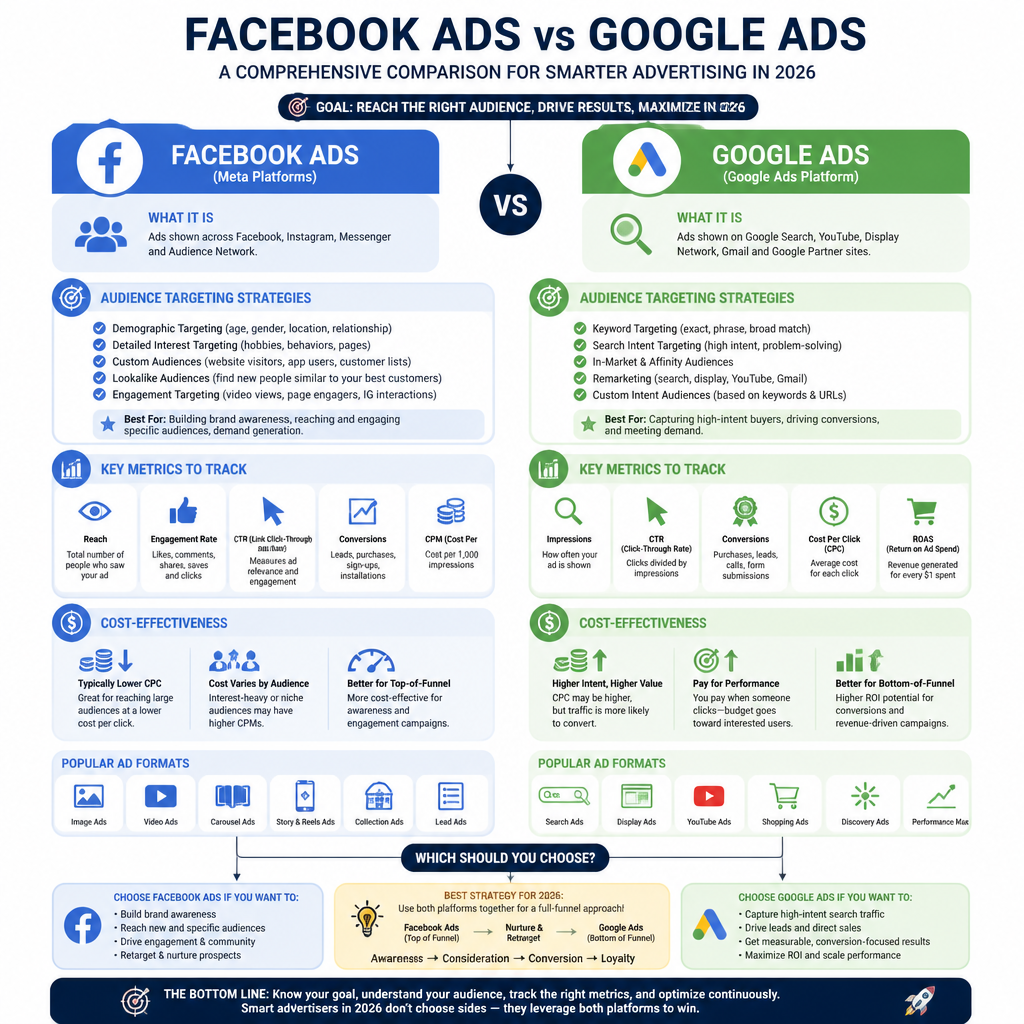
Understanding Facebook Ads vs Google Ads
Overview of Each Platform
Choosing between Google Ads and Facebook Ads hinges on one thing: where the user is in their head when you show up. Same product, totally different moment.
-
Google Ads is intent on tap. People tell you what they want, in plain language, then you bid to show up. When someone searches "best running shoes", they’re not browsing for fun—they’re delegating the decision to the search results. Your ad (and landing page) either makes the cut or it doesn’t.
-
Facebook Ads (Meta Ads) is interruption done well—or done terribly, if you’re lazy. Users aren’t asking to see your product. You’re inserting yourself into a feed while they’re half-watching a video and half-arguing in group comments. That sounds grim, but it’s also why Meta is so good at demand generation: you can reach people who didn’t wake up planning to buy, then shape what they want with creative.
Here’s the stance I’ve landed on after too many campaign post-mortems: Google punishes a weak funnel; Meta punishes weak creative. You can sometimes brute-force Google with bids for a bit, but it’ll get expensive fast. You can sometimes brute-force Meta with volume, but your CPA will drift upward until you’re paying for the same tired audience.
Key Differences in Targeting Strategies
The classic framing is still true, but the details matter.
-
Intent vs. Interest: Google Ads often targets users based on their intent to purchase, while Facebook Ads targets potential customers based on interests and past behaviors. Google is usually better for direct response when demand exists. Facebook is usually better for planting the seed and retargeting the people who showed a pulse.
-
Ad Formats: Google Ads is still dominated by text-based search ads (plus Shopping, Performance Max, Display, YouTube). Facebook offers feed videos, Stories/Reels, carousels, collection ads—the stuff that can explain, demo, and sell in the same swipe.
Now the 2026 reality: both platforms are converging.
- Google has more automation (PMax, broad match, smart bidding) and more upper-funnel inventory (YouTube, Discover).
- Meta is leaning harder into on-platform signals, AI-driven delivery, and creative variety to replace the targeting precision advertisers used to get “for free.”
So when people ask me, “Which is better?” I usually ask three questions back:
- Is there active search volume for what you sell? If yes, Google deserves a serious test first.
- Can you communicate the value in 3–10 seconds of video or a strong image + headline? If yes, Meta will scale.
- Do you have real conversion tracking (not vibes)? If no, both will lie to you—just in different ways.
A step-by-step way to choose (what I actually do)
If you’re stuck, here’s a practical sequencing that avoids a lot of regret:
-
Map your offer to the user’s moment.
- “Emergency” or urgent need (locksmith, same-day shipping, B2B software demo request) → start with Google.
- “Nice-to-have” or education-heavy (supplements, skincare, coaching, new SaaS category) → start with Meta.
-
Decide your primary conversion event.
- Google: purchase, lead, call, booking.
- Meta: same, but I’m stricter—if the event is noisy, Meta’s optimization can drift.
-
Pick one campaign to earn the right to expand.
- Google: 1 branded search + 1 non-branded search (tight) before you go wild.
- Meta: 1 prospecting campaign + 1 retargeting campaign, then creative iteration.
-
Set a two-week learning budget.
Not “test with $10/day and pray.” Give it enough spend to learn. If you can’t, your decision will be based on randomness.
Common mistakes I keep seeing
-
Using Google like a billboard. You can’t “brand build” your way out of irrelevant keywords. I’ve audited accounts where 30–50% of spend was going to searches that were technically related but commercially useless.
-
Using Meta like a search engine. People run one static ad that says “Buy now” and wonder why CPMs rise and frequency gets weird. Meta needs a story: problem, payoff, proof, angle, variation.
-
Comparing platforms on the wrong KPI. If you judge Meta only on last-click purchases, you’ll underinvest. If you judge Google only on volume, you’ll overpay.
Performance Metrics Comparison
Understanding Costs and ROI
Let’s talk numbers, but with the right caveat: averages hide brutal variance.
| Metric | Google Ads | Facebook Ads |
|---|---|---|
| Average CPC | $1 – $2 | $0.70 – $1.00 |
| Best for | High-intent traffic | Brand engagement |
| ROI Potential | Higher for immediate conversions | Higher for long-term brand loyalty |
A quick snapshot is helpful, but here’s what matters more than CPC in 2026:
- Cost per qualified click (not just any click)
- Conversion rate on the landing page
- Cost per acquisition (CPA)
- Incrementality (did ads create new sales or just steal credit?)
- Payback window (especially for subscription or repeat purchase brands)
Research from 2024 indicates that Google was projected to generate $62.87 billion in search ad revenue due to its strong performance in demand capturing (SEMrush). That tracks with what I see: when someone is already searching, Google is the cleanest place to catch them.
Facebook Ads, while cheaper, is increasingly effective for achieving high ROAS (Return on Advertising Spend) through ongoing engagement strategies, as evidenced by a trend toward visual ads that resonate with audiences (WordStream). Translation: if you can make strong creatives and keep refreshing angles, Meta can be a compounding asset.
What I look at weekly (platform by platform)
On Google Ads, I’m usually watching:
- Search terms (are we paying for nonsense?)
- Impression share (are we capped by budget or rank?)
- Conversion rate by query theme
- Landing page speed + message match (the silent killer)
On Facebook Ads, I’m watching:
- CPM + CTR (creative health)
- Frequency (are we burning out?)
- CPA by creative concept (not just by ad)
- Breakdown performance (placements, age, geo—carefully)
And yes, attribution is messy. I’ve seen Meta “undercount” when tracking is broken, and I’ve seen it “overcount” when you let view-through reporting steer decisions. Same with Google’s assisted conversions: useful, but it can make you feel invincible.
If you take only one tactical thing from this section, take this: run at least one holdout-style check. Even a crude one.
- Pause Meta prospecting in one region for 7 days (if your business can handle it) and compare.
- Or rotate budgets 80/20 for two weeks and watch what happens to total revenue, not just in-platform ROAS.
It’s not perfect science, but it’s better than worshipping dashboards.
Success Stories and Case Studies
- E-commerce Example: An e-commerce brand leveraging both platforms might use Google Ads to capture customers searching for specific products while employing Facebook Ads to retarget those who have previously visited their website. This two-pronged approach not only broadens reach but also strengthens brand recall, driving higher conversions across channels.
A case study highlighted on Wicked Reports illustrates that a well-structured campaign integrating both platforms resulted in a 35% increase in overall sales.
Here’s a real-world pattern I’ve seen (and fixed) that’s worth calling out.
Mini story: the “Google is working, Meta is trash” trap
A mid-sized DTC brand I worked with had this take after a month:
- Google: profitable
- Meta: expensive, inconsistent
We dug in and found two issues:
- Meta traffic was hitting a generic homepage, while Google search traffic landed on tight PDPs and collections. Meta wasn’t failing—the landing experience was.
- Meta was doing the heavy lifting up-funnel, then Google branded search was collecting the conversion and taking credit.
The fix wasn’t magical. We:
- Built one dedicated Meta landing page per core angle (not per product—per angle)
- Tightened the Google account to protect branded terms and high-intent non-branded terms
- Rebuilt Meta creative around 3 concepts (problem/solution, social proof, founder story)
The outcome: Meta CPA dropped, branded search didn’t “carry” the whole business, and total revenue smoothed out. That’s the win—less dependence on one channel’s mood swings.
Emerging Trends for 2026
The Rise of AI in Advertising
AI is no longer a “trend” you plan for. It’s the operating system both platforms are pushing you into.
As we look to 2026, one of the standout trends is the increased reliance on AI to enhance advertising performance across both platforms. AI tools are set to shape how advertisers strategize their campaigns, allowing for:
- Predictive Analytics: Understanding user behavior and predicting future actions.
- Dynamic Creative Optimization: Tailoring ads in real-time based on user interactions, leading to more personalized experiences.
According to the 2026 Digital Advertising Trends Report, embracing these technologies will be crucial for marketers looking to maintain a competitive edge in the crowded space of digital advertising.
My opinionated take: automation is great at allocation, not at meaning.
- Google’s automation can route spend toward what converts given your current inputs.
- Meta’s automation can find pockets of performance if you feed it strong creatives and clean events.
But neither platform will save a weak offer or confusing positioning. I’ve watched Performance Max campaigns spend heavily on junk placements because the asset group was vague and the product feed was sloppy. I’ve also watched Meta’s Advantage+ audiences drift toward low-quality leads because the conversion event was “Lead” with no qualification and no offline feedback loop.
Step-by-step: how to use AI without letting it drive the car off a cliff
- Choose one “north star” conversion event per campaign. Don’t mix “add to cart” and “purchase” optimization in the same breath.
- Control your inputs.
- Google: clean product feed, tight brand controls, negative keyword hygiene where applicable.
- Meta: creative volume (new angles), clean pixel/CAPI events, exclusions where they still matter.
- Audit where the algorithm is spending. Weekly. Non-negotiable.
- Add human guardrails:
- Creative rules (what claims you won’t make, what you must show)
- Landing page rules (message match, load time)
- Profit rules (margin-aware bidding if you can)
Privacy and Data Considerations
Privacy changes didn’t “end targeting,” but they changed what’s reliable.
With growing concerns over privacy and data usage, both platforms are under pressure to comply with new regulations. This implies:
- Increased Transparency: Expect both platforms to implement stricter data handling practices, impacting how ads are targeted.
- Shift in Strategy: Marketers may need to pivot towards contextual targeting rather than relying solely on personal data, aligning with evolving consumer expectations around privacy.
Where this gets practical in 2026:
- First-party data matters more (email/SMS lists, customer match, post-purchase surveys).
- Creative becomes targeting. The angle you choose decides who stops scrolling.
- Server-side tracking and clean event pipelines separate adults from children. If your purchase event fires twice, or not at all, the algorithm will “learn” garbage.
Common mistake: teams keep changing five things at once (new creatives, new landing page, new offer, new tracking) and then declare the platform “dead” when performance swings. With less deterministic tracking, you need cleaner experiments—one meaningful change at a time.
Conclusion: Making the Right Choice
If you’re forced to choose one: Google Ads is usually the better bet for capturing existing demand; Facebook Ads is usually the better bet for creating and shaping demand. Most businesses that grow past a plateau end up using both—because the customer journey isn’t one moment.
Here’s the decision framework I’d actually use going into 2026:
-
Lean Google Ads if:
- People already search for your product/service (clear intent)
- Your margins can handle CPC volatility
- Your landing pages convert and your offer is straightforward
-
Lean Facebook Ads if:
- You need to educate the market or differentiate in a crowded space
- You can produce a steady stream of creative (and test angles weekly)
- You care about repeat purchases, community, or brand preference
A practical “both platforms” setup (simple, not fancy)
If you have enough budget to run both, this is a clean starting structure:
- Google Search (core intent): protect branded terms + bid on 5–20 high-intent non-branded keywords.
- Meta Prospecting (creative testing): run 3–5 creative concepts, each with 2–4 variations.
- Meta Retargeting: focus on site visitors, engaged video viewers, and cart starters—with fresh proof (reviews, UGC, guarantees).
- Measurement: track CPA and blended ROAS, and sanity-check with at least one holdout or budget rotation.
Persona anecdote: what I’d do if I were you next week
If you told me, “I’ve got $3k to test and I need an answer fast,” I’d do this:
- Week 1–2: launch a tight Google Search campaign + one Meta prospecting campaign with two strong creatives.
- Week 3: keep what’s converting, kill what isn’t, and add retargeting only after you have enough traffic.
- End of week 4: decide based on blended cost per purchase/lead and what the funnel can support—not based on whichever dashboard flatters you.
The next step is simple: pick the platform that matches the customer’s moment, then run a disciplined 30-day test with real tracking and ruthless creative iteration. That’s how you stop guessing and start scaling.
Leave a Reply