Explore the rich symbolism of blood upon the snow and its meanings in literature and art.
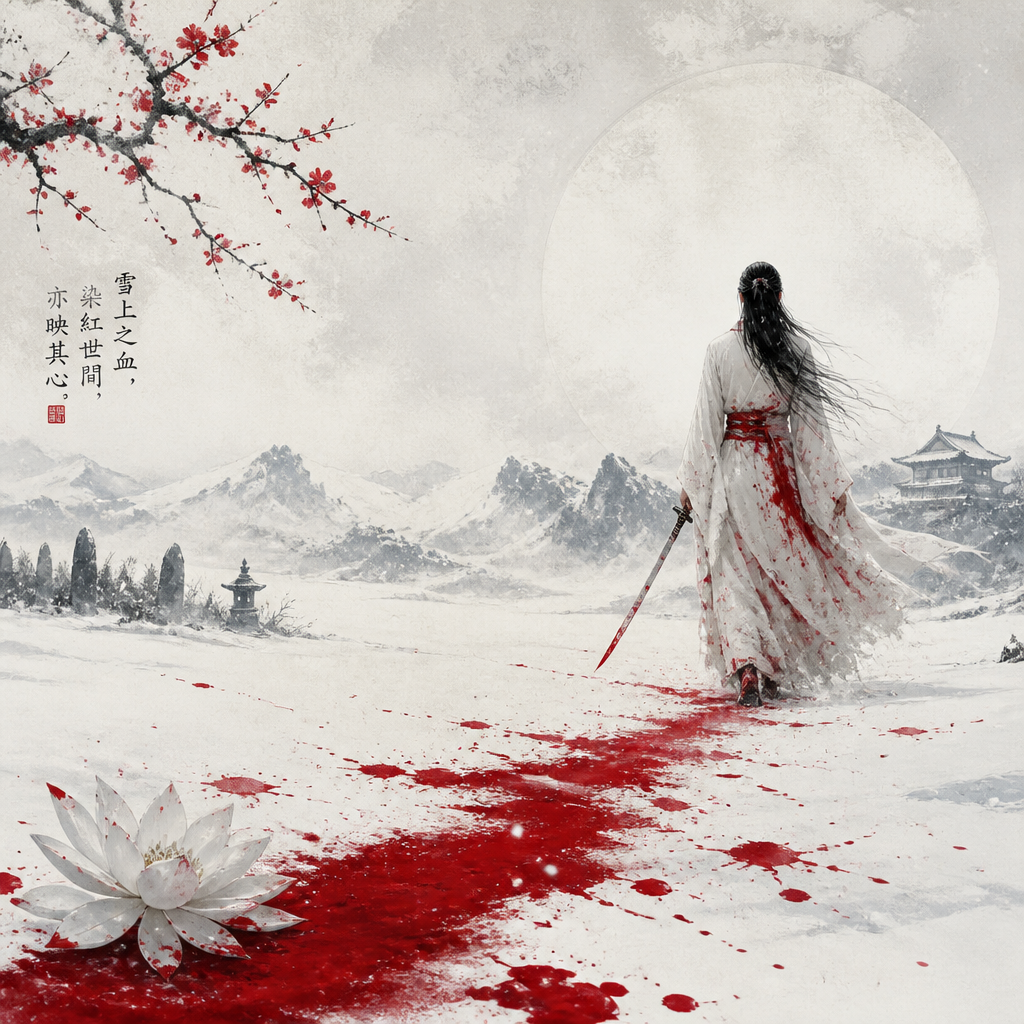
Exploring the Multi-Layered Symbolism of Blood Upon the Snow
Understanding the Surface Meaning
“Blood upon the snow” works because your brain reads it in two passes.
First pass is pure sensory impact: red on white, warmth on cold, life on something that should be clean. It’s hard not to stare at it. Even if you’ve never studied symbolism, you still get the emotional signal: something went wrong here.
Second pass is meaning. Blood tends to carry life-and-death stakes (injury, violence, birth, sacrifice, kinship). It can also stand in for the invisible stuff—guilt, complicity, desire, shame—because blood is intimate. It comes from inside.
Snow usually reads as purity and innocence, but it’s also silence, isolation, erasure, and the way the world looks when it’s been temporarily reset. Snow covers tracks until it doesn’t. It preserves bodies. It muffles sound. In a lot of stories, snow isn’t gentle; it’s indifferent.
Put together, blood upon snow becomes a kind of moral highlighter. Whatever happened can’t be ignored. The scene tells you: a boundary was crossed.
Exploring Historical Contexts
Once you move past the first gut reaction, the image starts picking up cultural baggage.
Across mythologies and religious narratives, blood has been used to mark sacrifice—a trade with the divine, a payment, a proof of devotion, a cleansing, or a curse. That history matters because it changes how we read the stain. Is it a crime scene? A ritual? A martyr’s signature?
Snow’s cultural meaning shifts too. In some traditions it’s tied to purity and spiritual cleanliness; in others it’s famine, exposure, and the brutal reality of winter. Folklore loves snow because it can look like a blank page while hiding the worst things underneath.
A classic example people recognize is Snow White: the bright snow, the red blood, and the black hair. That triad is basically a ready-made symbol kit—innocence, mortality, and the uncanny. Even if you don’t quote the text, you can feel what the story is doing: it stages innocence so it can be threatened.
Analyzing Advanced Interpretations
At the more technical end—when you’re looking at modern vs. classical uses—the motif becomes less about “purity ruined” and more about who benefits from calling something pure in the first place.
In contemporary art, blood on snow can be used to accuse: state violence, war, gendered harm, colonization, environmental collapse. The snow becomes a false alibi (“look how clean this place is”), and the blood becomes the truth leaking through.
Psychologically, the contrast is doing a lot of work. White space often signals safety and control; blood is bodily and uncontrollable. That tension can be used to show:
- Reality intruding on idealism
- Repressed violence surfacing
- The cost of survival (someone always bleeds)
I’ve seen artists lean on this too hard—thinking the palette alone creates depth. It doesn’t. The meaning comes from context: who bleeds, why, and what the snow is “pretending” to be.
The Components of Blood and Snow
Blood: Life, Death, and Sacrifice
Blood is never neutral in a story. It’s a substance with a built-in verdict.
Yes, it signals injury and death. But it also signals agency. Somebody acted, or something happened that can’t be taken back. Even accidental bleeding reads as consequence.
A useful way to think about blood symbolically is to ask what kind of blood it is in the narrative:
- Blood as proof (a witness you can’t bribe)
- Blood as price (what it cost to get this outcome)
- Blood as inheritance (family, lineage, “blood ties”)
- Blood as contamination (guilt, curse, moral rot)
Take Macbeth. The blood there isn’t just gore—it’s bookkeeping. Every violent choice gets tallied. Macbeth can’t wash it off because it isn’t really on his hands; it’s in his decisions.
A quick real-world-ish reading move I use: if a character sees blood and immediately tries to hide it, you’re in guilt territory. If they display it, you might be in martyrdom, warning, or intimidation territory. Same blood. Different story.
Common mistake I see in student essays: treating blood as a universal symbol with one meaning (“blood = death”). That flattens the text. Blood can mean death, sure—but it can also mean birth, loyalty, betrayal, survival, or devotion. You have to earn your interpretation from the scene.
Snow: Purity and Innocence
Snow looks simple until you pay attention to what it does.
Snow can absolutely represent purity and innocence—freshly fallen, untouched, almost ceremonial. But snow also:
- Erases (tracks disappear, evidence gets covered)
- Reveals (a single footprint or stain becomes obvious)
- Preserves (bodies, secrets, the past)
- Isolates (roads close, help doesn’t come)
When a narrative uses snow as the setting, it often wants you to feel either (a) the romance of cleanliness or (b) the threat of indifference. Sometimes both at once.
Here’s an anecdote from a critique circle I ran: a painter brought in a winter scene with a tiny red mark near a fence line. Half the room read it as “violence” immediately. The painter insisted it was a dropped scarf. That gap—between what the creator intended and what the audience can’t help but feel—is exactly why this motif is powerful. Snow makes tiny disturbances feel like crimes.
So when blood hits snow, it’s not just “innocence ruined.” It’s also “the world keeps receipts.” Snow is a bright ledger.
How It Works: Analyzing Context and Character Motivations
This symbol only lands if the story gives it a job. Here’s the step-by-step way I break it down when I’m annotating a text or writing a gallery review.
-
Identify the immediate context
- Where are we, literally?
- Is the snow a backdrop (aesthetic) or an obstacle (survival)?
- Is the blood fresh, drying, spattered, pooled, smeared?
Spatter suggests struggle. A clean drip suggests a small wound—or a controlled act. A smear suggests panic, cover-up, or someone being dragged.
-
Name the action that created the blood
This is where people get lazy. Don’t just say “there is blood.” Ask:- Who caused it?
- Was it intentional?
- Was it justified in the character’s mind?
-
Track character motivation in the moment
Are they:- protecting someone?
- punishing someone?
- trying to survive?
- making an example?
- performing devotion?
Motivation changes the symbolism. “Blood as sacrifice” and “blood as cruelty” can look identical on the snow.
-
Look at who witnesses the stain
The observer matters. If a child sees it, you’re probably in innocence-loss territory. If a soldier sees it, it might be normalization or numbness. If the perpetrator sees it, it’s guilt or pride. -
Zoom out to cultural and genre expectations
A fairy tale uses this image differently than a war novel. A romantic tragedy uses it differently than a protest mural.
Common mistake: people skip steps 2 and 4. They jump straight from “blood + snow = symbolism” to a thesis about mortality. But symbolism rides on causality and witness. Always.
Analogies and Misconceptions
Blood Upon the Snow as a Metaphor
If you want a clean analogy, think of a red rose shoved into a bouquet of white flowers. It dominates. It redirects the mood. It forces a new reading: romance, danger, grief—depending on context.
But I actually prefer a less pretty comparison: it’s like hearing a single sharp note during a quiet song. Not loud, just wrong. Your body reacts before your brain explains.
That’s what the motif does: it interrupts. Snow gives you calm; blood breaks the contract.
Addressing Common Misconceptions
A few misconceptions I keep seeing—especially online—make analysis feel shallow.
-
Misconception #1: “It only means death.”
Not always. Blood can signal survival (you’re alive because you can bleed), or rebirth (old self dies, new self begins), or even truth (the lie can’t hold). -
Misconception #2: “Snow always means innocence.”
Snow can mean erasure or indifference. Sometimes the snow is the villain—cold, uncaring, endless. -
Misconception #3: “The contrast is the point.”
Contrast is the hook, not the meaning. The meaning comes from narrative pressure: what changed because the snow was stained?
A practical way to test yourself: write two sentences.
- “The blood on the snow represents ____.”
If you can fill that blank with five different plausible options, good—you’re seeing range. Then pick the one that the scene’s details support best.
Applications in Literature and Art
Literary Analysis: Shakespeare’s Macbeth
Macbeth is basically a long meditation on action and aftermath. Blood is everywhere, and it keeps returning as a symbol of guilt and moral corrosion.
Even when there’s no literal snow in the play, the logic of “blood upon the snow” is there: a violent act against a backdrop that’s supposed to be orderly, legitimate, and clean. Kingship is the “white field.” Murder is the stain.
If you want to apply the motif cleanly, do it like this:
- White field (social order): the natural order of succession, hospitality rules, loyalty vows.
- Stain (blood): Macbeth’s choice to violate those rules.
- Afterimage: paranoia, hallucination, the sense that the world has been permanently marked.
I’ve watched readers miss what Shakespeare is doing by treating blood as decoration. It isn’t. It’s the play’s moral accounting system.
Art Critiques: Edvard Munch’s The Scream
Munch’s The Scream isn’t a literal “blood on snow” image, but it often gets discussed with that same emotional contrast: a distorted figure against a world that looks strangely clean or unreal.
The reds and oranges in the sky can feel like bleeding—like the environment itself has been wounded. Set against cooler tones, the effect echoes the blood/snow dynamic: an eruption of feeling against a surface that can’t contain it.
Here’s the part I think matters in critique: the image doesn’t just show fear; it shows contagious fear. The landscape participates. That’s a modern use of the motif’s core move—violence or pain isn’t confined to the body. It stains the whole scene.
A real example from museum-going life: I once heard someone say, standing in front of an expressionist canvas, “It’s just messy color.” When you train yourself on motifs like blood-on-snow, you start asking: what is the “clean field” here, and what is breaking it? Even abstract art often has that structure.
Related Concepts: Sacrifice and Innocence
Sacrifice
Blood and sacrifice are old companions. In narrative terms, sacrifice is how writers make meaning out of loss—loss that does something.
When blood is shed on snow, sacrifice can read as:
- Public and undeniable (the whiteness makes it visible)
- Coldly transactional (winter doesn’t care that you meant well)
- Purifying or damning (depending on who tells the story afterward)
Step-by-step, to see whether you’re dealing with sacrifice instead of mere violence:
- Did the character choose the harm (or accept it) for a reason beyond themselves?
- Does the narrative frame it as necessary, holy, tragic, or pointless?
- What changes because of the blood—does anyone learn, live, escape, or get redeemed?
Common mistake: calling any death a sacrifice. A sacrifice has a stake attached. If nothing is gained, revealed, or transformed, it may be closer to waste—or indictment.
Innocence
Snow makes innocence tempting because it looks untouched. But innocence in stories is rarely stable; it’s usually a temporary condition.
When blood stains snow, innocence can be lost in different ways:
- Initiation: a character sees the real world for the first time.
- Complicity: the character benefits from harm, even indirectly.
- Corruption: the character chooses harm and can’t return.
An anecdote from editing: I worked with a short-story writer who kept inserting “blood on the snow” moments as a shortcut to seriousness. The breakthrough draft was the one where the blood wasn’t from the obvious victim—it was from the protagonist who tried to help and failed. Same image, totally different meaning. Innocence didn’t vanish because of violence alone; it vanished because the character learned their limits.
Conclusion
Blood upon the snow symbolism isn’t subtle—and that’s why it lasts. It’s an image that forces you to read consequence into the landscape.
If you want to interpret it well, don’t stop at “red vs. white.” Ask who bled, who watched, what the snow was doing before it was stained, and what can’t be cleaned up afterward. That’s where the real meaning lives.
Next time you run into this motif—on a page, in a film frame, or on a gallery wall—pause and do the five-step read. You’ll feel the image hit, and you’ll also be able to explain why it hit.
Leave a Reply