Explore the key trends in email marketing for 2026, focusing on AI, personalization, and data privacy.
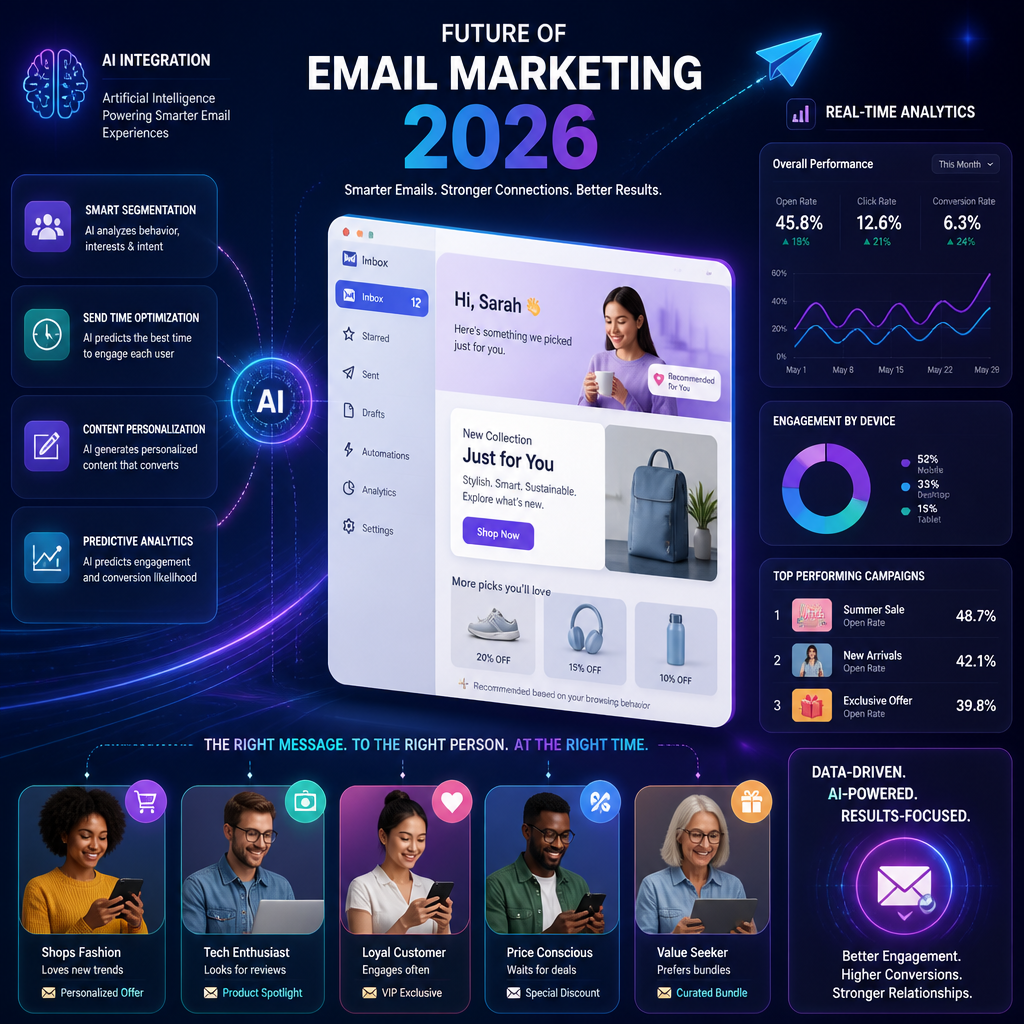
Understanding the Landscape of Email Marketing in 2026
The landscape in 2026 looks “advanced” on the surface—AI copy, predictive send times, dynamic blocks—but the truth is email is still judged by the same ruthless metric it always was: does the recipient care enough to open, click, and act?
Email marketing has evolved from one-size-fits-all newsletters into highly personalized, behavior-driven messaging. That shift happened because inboxes got crowded and consumers got picky. And because the tools got better. But tools don’t save you from bad strategy.
A few realities I plan around when I’m QA-ing or advising on campaigns:
- Reach is not the problem. As of 2026, there are about 4.8 billion email users worldwide, and that number is projected to grow. Email is still where your customers live.
- Attention is the problem. Everyone is sending more emails. That means “pretty template + 10% off” is background noise.
- Mobile and rendering are still quietly killing performance. If you haven’t run a template through real device + real client previews lately, you’re guessing.
Litmus’s ROI number is a big part of why email stays on the shortlist even when budgets tighten: $36 for every $1 spent (Litmus). I’ve seen that play out most clearly when teams stop treating email as a broadcast channel and start treating it like a product experience—welcome flows, post-purchase education, replenishment reminders, winbacks.
Current Email Engagement Statistics
There’s a tension that shows up in most lists: people want to hear from brands… but not like that.
One stat I come back to when shaping cadence and segmentation: 86% of consumers would like to receive promotional emails from companies they do business with at least monthly, and they prefer emails tailored to their interests (OptinMonster).
What that means in practice:
- Monthly promos are tolerated (even welcomed) if they’re relevant.
- Generic promos become “why am I getting this?” real fast.
A mistake I see constantly: teams interpret “send less” as the fix. Sometimes you should send less, sure. But more often, you should send smarter—split your list by intent signals (recent browse, last purchase category, lifecycle stage) and let those segments dictate content.
A quick QA-flavored example: I once tested an ecommerce promo where the segmentation logic was “purchased in last 90 days.” Sounds fine—until you realize it scooped up people who bought a gift once, then never engaged again. The result: higher complaint rate, lower deliverability, and the “best customers” got the same email as everyone else. The fix wasn’t redesign. It was redefining segments (repeat buyers vs one-time, category affinity, and engagement recency).
Key Trends in Email Marketing
The trends that matter in 2026 aren’t shiny because they’re new. They matter because they solve real friction: relevance, speed, and trust.
1. Rise of AI and Machine Learning
AI is no longer a buzzword you toss into a deck. It’s operational.
Used well, AI helps you:
- Predict what a subscriber is likely to click based on past behavior
- Personalize content blocks without building 40 manual segments
- Optimize send time and frequency so you’re not over-mailing (or under-mailing)
A case study from Done For You highlighted 25–122% higher open rates using AI in email campaigns.
How I’d actually implement this (step-by-step):
- Start with one flow, not the whole program. Welcome series is the easiest place to measure lift because intent is high.
- Define one “AI decision.” Example: subject line variant selection, or product recommendations, not both.
- Lock your measurement window. Same list, same duration, same deliverability settings—otherwise you’ll attribute random noise to “AI.”
- QA the edge cases. Missing first name, empty recommendation set, suppressed categories, unsubscribed-but-still-triggered contacts.
Common mistake: teams let AI generate copy and skip brand review. The output is often “fine,” but “fine” can still break brand voice, compliance rules, or just sound weirdly generic. I’ve seen AI confidently invent shipping promises and discount terms that weren’t real. That’s not a creative problem—it’s a legal and CX problem.
2. Interactive and Multimedia Emails
Interactive and multimedia content is climbing because it earns attention faster than text walls.
One of the clearest stats here: emails containing video content can increase click-through rates by 300% (Wyzowl).
That doesn’t mean you should stuff a video into every message. It means video is a high-leverage format when you have something visual to demonstrate—product walkthroughs, feature reveals, customer stories, onboarding.
Real-world scenario I’ve watched play out:
- Brand launches a new feature.
- They send a long “here’s what’s new” email.
- Support tickets spike because people still don’t get it.
Swap in a short video thumbnail + one clear CTA (watch / try it), and suddenly the email does what it’s supposed to do: move the user forward.
Common mistake: embedding video incorrectly. Many email clients don’t support true embedded video playback. The safer pattern is a clickable thumbnail (or GIF preview) that lands on a page where the video plays.
3. The Importance of Data Privacy
Privacy isn’t a checkbox anymore. It’s part of why people stay subscribed.
Regulations like GDPR changed what “good” looks like, and consumer expectations keep tightening. If you’re vague about data use, people don’t debate it—they unsubscribe.
Mailjet has a practical breakdown on GDPR and email marketing compliance (Mailjet). The big takeaway I care about: companies that respect privacy and consent build stronger relationships.
What I push for (even when teams resist):
- Clear preference centers (frequency + topics)
- Double opt-in where list quality matters
- Sunset policies for unengaged contacts (it helps deliverability and trust)
Common mistake: hiding behind “legitimate interest” and blasting everyone forever. You might get away with it short term. Long term, your deliverability pays.
The Impact of AI and Automation in Email Strategies
AI and automation are changing email strategies because they turn “manual marketing work” into systems.
The upside is obvious:
- Automated flows respond instantly to behavior (browse, cart, purchase, churn signals)
- Segmentation can be updated dynamically instead of via static exports
- Performance insights can be surfaced faster than a weekly report cycle
Brands using AI-driven solutions have reported ROI improvements exceeding 300% (Done For You).
But here’s the part that doesn’t get said enough: automation amplifies whatever you already are. If your logic is sloppy, automation makes the sloppiness scale.
A QA-ish mini story from the trenches:
I once tested an automated post-purchase series where the “if delivered then send review request” condition was wired to the wrong event. Customers were asked for reviews before packages arrived. Not “eventually,” not “once.” Repeatedly, because the workflow didn’t have a guardrail.
We fixed it by:
- Switching the trigger from “order fulfilled” to a delivery-confirmed signal (or a timed delay fallback)
- Adding a “do not send if refund initiated” condition
- Capping sends (one review request per order)
That’s what 2026 email looks like: not just content, but logic design.
Common mistakes with AI + automation:
- Automations that don’t respect time zones (hello, 3 a.m. sends)
- Multiple flows competing (welcome + promo + cart all firing within 24 hours)
- No suppression rules for support cases or high-risk segments
If you do nothing else this year, build a basic “message governance” doc: what wins when triggers collide, how many emails/day max, what events suppress promos.
Trends Shaping the Future: Video and Dynamic Content in Emails
Embracing Video Content
Video works in email because it compresses information. You can show in 12 seconds what takes 200 words to explain.
beehiiv notes that adding video content to emails can lead to up to 48% more clicks (beehiiv).
How I’d use video in 2026 without breaking everything:
- Use a static image thumbnail with a play button overlay
- Link to a landing page where the video is hosted (fast load, mobile friendly)
- Track clicks with UTM parameters so you can attribute downstream conversions
A practical example:
If you’re a SaaS company launching a new reporting dashboard, send:
- Subject: “Your new dashboard is live (2-minute walkthrough)”
- Body: one sentence on the value, thumbnail to the walkthrough, one CTA: “See it in your account”
Don’t add three CTAs and a mini novel. Video is the feature.
Dynamic Content for Enhanced Personalization
Dynamic content is one of those features that sounds fancy until you use it once—then you wonder how you lived without it.
Dynamic blocks let the email change based on user data: location, lifecycle stage, purchase category, browsing behavior. That’s how you stay relevant without building and maintaining 25 separate campaigns.
Step-by-step: a sane way to roll out dynamic content
- Pick one dimension (e.g., “category last purchased”)—not five.
- Create 3–5 content variants max. More than that and QA becomes a swamp.
- Define fallbacks (if category is unknown, show bestsellers).
- Test with real contacts that represent each variant. Don’t just preview in your ESP.
Common mistake: teams forget the fallback. Then a chunk of the list gets a broken block or blank space. Nothing tanks confidence like an email that looks unfinished.
Creating an Engaging Email Strategy for 2026
If you want an engaging email strategy in 2026, build it like a system: right message, right person, right time, with guardrails.
Optimizing Subject Lines and Call-to-Actions
Subject lines still matter because they’re the gatekeeper.
OptinMonster cites that personalized subject lines resulted in a 26% increase in open rates (OptinMonster).
My stance: personalization works when it’s real personalization. Not just “Hey {FirstName}”.
Better subject line personalization ideas:
- Based on category affinity: “New arrivals in the gear you actually buy”
- Based on lifecycle: “Your refill reminder (before you run out)”
- Based on behavior: “Still thinking about that desk chair?”
CTA rule I enforce: one primary action per email. Secondary links are fine, but only one “big button” goal.
Integrating AI Solutions
AI should be used to remove repetitive decisions, not to outsource your thinking.
Good AI use cases in email:
- Predictive send time optimization
- Product/content recommendations
- Automated segmentation updates
- Drafting variants for A/B tests (with human review)
Bad AI use cases:
- Letting it write legal/offer language without oversight
- Letting it “personalize” using sensitive attributes you shouldn’t be using
Importance of A/B Testing
A/B testing isn’t a ritual—it’s how you avoid arguing by opinion.
A testing workflow that actually works (and doesn’t waste weeks):
- Test one variable at a time (subject, CTA, hero image, offer framing)
- Predefine success (opens for subject tests, clicks for content tests)
- Run it long enough to matter (not 2 hours, unless your list is huge)
- Log results in a shared doc so you don’t “rediscover” the same lesson next quarter
Common mistake: teams test subject lines, pick the winner, then never reuse the learning. If you learned “benefit-first beats curiosity,” bake that into your copy guidelines.
Frequently Asked Questions about Email Marketing Trends
-
What are the top email marketing trends for 2026?
AI-driven personalization, smarter automation, more video/interactive content, dynamic blocks, and a tighter focus on data privacy are the big ones. I’d also add: better governance for triggered flows, because overlapping automations are a 2026 headache. -
How can businesses prepare for the future of email marketing?
Do three things in order: clean up segmentation, tighten consent/privacy practices (see Mailjet), and then layer in AI where it removes repetitive work. -
Is it worth investing in email marketing in 2026?
Yes—email continues to deliver high ROI. Litmus reports $36 for every $1 spent (Litmus). But the “worth it” part depends on list quality and relevance, not just send volume. -
What role does data privacy play in email marketing?
It’s foundational. Transparency and consent aren’t just legal—they affect unsubscribe rates, complaint rates, and brand trust. If you’re sloppy, deliverability eventually punishes you. -
How can I improve email open rates going forward?
Start with segmentation and subject lines. OptinMonster reports a 26% open rate lift from personalized subject lines (OptinMonster). Then make sure your “from name” and preview text match the promise. -
What tools are best for email marketing in 2026?
The “best” tool is the one your team can operate without duct tape. Mailchimp, HubSpot, and ActiveCampaign are common choices, but whichever you use, budget time for template QA and automation logic testing. That’s where the real failures hide.
My Experience With Email Marketing
I’m Mariaa, and my angle is a little different because I come from QA. I’m the person who asks annoying questions like: “What happens if the first name is null?” and “What happens if someone unsubscribes between trigger and send?”
Over the last decade, I’ve watched email teams make the same painful mistakes—then act surprised by the results.
One memorable one: a brand migrated to a new ESP and didn’t validate their suppression lists correctly. They accidentally re-mailed people who had opted out months earlier. Complaints shot up, deliverability dipped, and suddenly the entire program’s performance looked ‘mysteriously’ worse.
Here’s the checklist we used to get back to normal:
- Export and reconcile suppression lists (global + category-specific)
- Verify double opt-in settings weren’t reset
- Warm up sending domains/IPs gradually (no sudden volume spikes)
- Rebuild the welcome flow first (highest intent), then promos
Since then, I’m biased toward boring, reliable operations: clean data, clear consent, and automations that don’t fight each other.
Next step: pick one high-impact area—welcome series, cart flow, or post-purchase education—and rebuild it with one AI-assisted personalization layer and proper QA. If you can make one flow feel eerily relevant, the rest of your 2026 strategy gets a lot easier.
Leave a Reply