Uncover the key DevOps tools and technologies to adopt in 2026 for enhanced collaboration and efficiency.
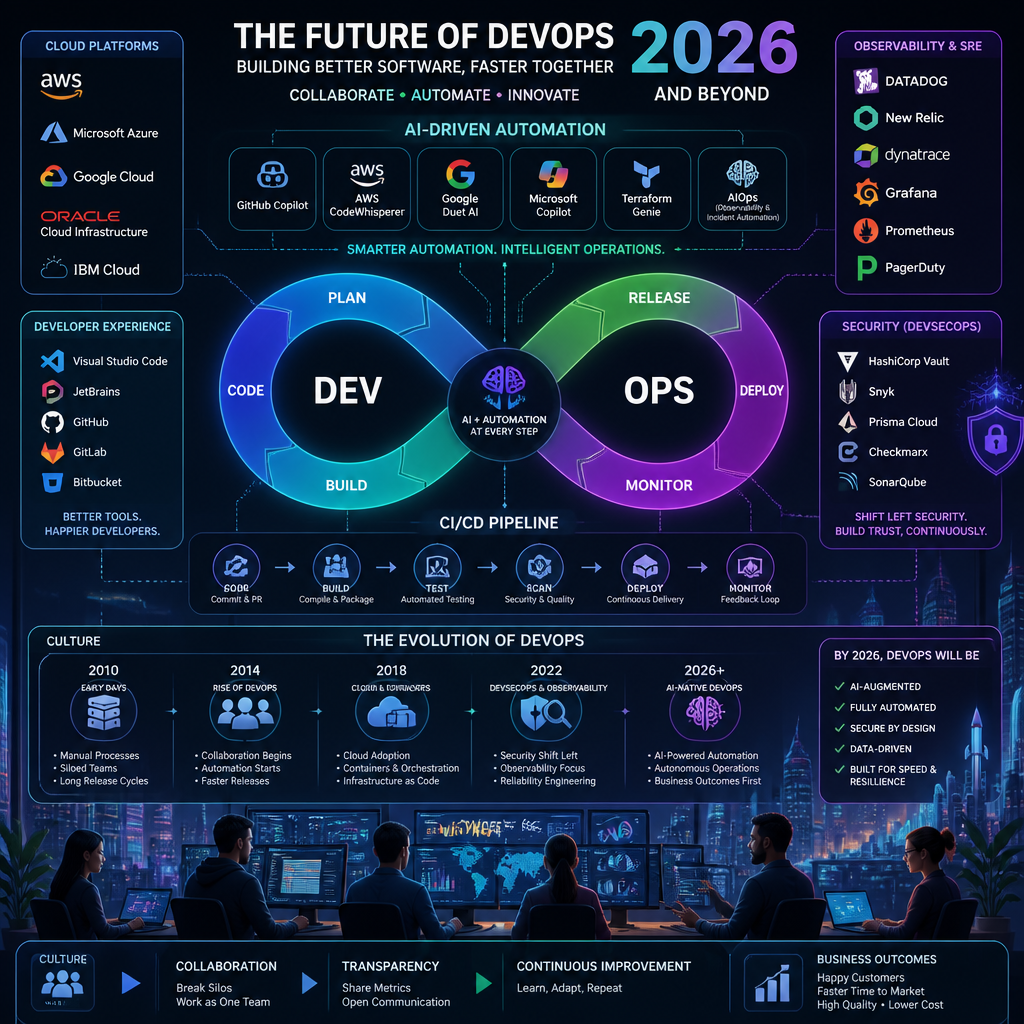
Understanding the Future of DevOps
The future of DevOps is less about a shiny new CI server and more about closing the loop: code → build → deploy → observe → learn → improve, with fewer humans doing repetitive glue work.
Here’s the pressure that’s forcing the change:
- More complexity per release. Microservices, event-driven architectures, and third‑party APIs mean one feature can touch 10 systems.
- More releases per week. When you deploy daily (or hourly), manual checklists stop working.
- More compliance and security expectations. Security reviews are getting pulled left into PRs and pipelines—whether you like it or not.
And the money is clearly following that reality. The DevOps Automation Tools Market is expected to grow from USD 8.635 billion in 2024 to approximately USD 55.907 billion by 2032, at a CAGR of 26.3% (Credence Research). That doesn’t happen because vendors got better at marketing. It happens because automation is now a survival skill.
The Evolving DevOps Roadmap
A DevOps roadmap is only useful if it prevents two common failure modes:
- Tool sprawl (every team picks their own stack, and nobody can support it).
- Automation theater (pipelines exist, but they’re slow, flaky, and bypassed when it matters).
If I’m building a roadmap for 2026, I’m anchoring it on a handful of capability areas, not brands:
-
AI and Automation
- AI isn’t magic. But it is good at speeding up the annoying parts: summarizing incident timelines, suggesting test cases, spotting risky diffs, and triaging alerts.
- The goal is fewer human cycles spent on repeatable steps—linting, dependency updates, environment provisioning, and compliance evidence collection.
-
Cloud-Native Tools
- Cloud-native isn’t “we run in the cloud.” It’s designing around managed services, immutable infra, and automation-first operations.
- This is also where platform engineering shows up: paved roads, shared templates, and opinionated defaults.
-
Continuous Integration and Delivery (CI/CD)
- CI/CD is still the backbone. What changes by 2026 is the expectation: pipelines should be fast, deterministic, and observable.
- If your pipeline can’t explain why it failed (or how to reproduce it locally), it’s not a pipeline—it’s a slot machine.
A lot of teams are already prioritizing automation and AI integration. You can see that direction reflected in the DORA 2024 report, which lines up with what I’m seeing in real orgs: the winners are the ones reducing toil and tightening feedback loops.
A real example I’ve seen: a mid-size SaaS team tried to “modernize DevOps” by adopting Kubernetes, a service mesh, two different CI tools (because two teams disagreed), and an experimental GitOps controller—all in one quarter. They shipped less, not more. The fix wasn’t another tool. It was picking a single delivery path, enforcing standards via templates, and making observability non-negotiable before scaling complexity.
Key Tools and Technologies for 2026
This is the part where most articles list 30 logos. I’m not doing that. In practice, you’ll pick a small set of tools—but you need the right categories covered, with sane boundaries.
AI-Driven Automation Software
AI-driven automation will be a big piece of DevOps in 2026, but only if you treat it like an assistant, not a pilot.
Where it actually helps in the real world:
- PR assistance: flagging risky changes (like config edits, auth changes, or high‑churn files).
- Test generation suggestions: especially for edge cases people forget.
- Incident response: summarizing alert storms into likely root causes and correlating deploys with error spikes.
- ChatOps workflows: “deploy service X to staging with version Y” becomes a controlled action, not tribal knowledge.
There’s some evidence that AI assistance can improve delivery outcomes. For instance, organizations using AI-assisted development practices reported decreases in deployment times and reductions in operational errors (WJARR).
Common mistake: letting AI touch production changes without guardrails. If you adopt AI code assistants, pair it with:
- mandatory code review for high-risk areas
- policy checks (IaC scanning, secret detection)
- protected branches and signed commits/tags
- deployment approvals based on risk (not based on someone’s job title)
Enhanced Monitoring Solutions (Observability That’s Actually Usable)
By 2026, “monitoring” that only tells you CPU and memory is table stakes. You’ll want:
- traces that follow a request across services
- logs that are structured and searchable (not just big text blobs)
- metrics that match user experience (latency, error rate, saturation)
- SLOs that define what “good” means
Proactive monitoring matters because the cost curve is ugly: the longer an incident runs, the more it eats engineering time and customer trust.
Mini story: I once watched a team drown in alerts because every pod restart paged someone. The real signal—checkout latency—was buried. We fixed it by (1) defining SLOs, (2) paging only on user-impacting symptoms, and (3) moving noisy infrastructure alerts to dashboards and daily reviews. Same tools, radically different outcomes.
Integrated Development Environments (IDEs) with DevOps Capabilities
IDEs are turning into “delivery consoles.” The upside is speed: developers can run tests, validate pipelines, and trigger deployments without context switching.
The downside is governance. If every developer can deploy from their IDE with one click, you’d better have:
- environment protections
- audit trails
- consistent pipeline steps (so “it worked on my machine” doesn’t become “it bypassed CI”)
What I like: IDEs that surface pipeline failures with actionable hints, link directly to logs/traces, and let you reproduce CI steps locally (same container image, same command).
Cloud-Native Delivery: Containers, GitOps, and Policy as Code
This is where 2026 gets practical:
- Containers are still the unit of deployment for many teams.
- GitOps patterns keep desired state in Git and let automation reconcile environments.
- Policy as code (for infra, security, and compliance) reduces “handshake” approvals that slow teams down.
Tradeoff: GitOps adds safety and repeatability, but it can also add latency if you don’t tune reconciliation, promotion workflows, and drift handling. It’s not free. It’s worth it when you care about auditability and consistency.
How to Prepare for the Future of DevOps
If you’re preparing for 2026, don’t start by buying tools. Start by tightening the system you already have.
Here’s a step-by-step approach I’ve used that doesn’t create chaos.
1) Research and Identify Tools (but start from pain)
Do this in a week, not a quarter.
- List your top 5 sources of delivery pain: flaky tests, slow builds, manual approvals, unclear ownership, incident handoffs.
- Map each pain to a capability: caching, test selection, policy checks, deployment automation, better observability.
- Only then evaluate tools.
Common mistake: adopting a tool because a competitor uses it. Different orgs have different constraints—regulated environments, latency needs, team maturity.
2) Evaluate Current Practices (baseline your reality)
Before you “improve DORA metrics,” measure what’s happening now.
- How long does CI take on an average PR?
- How often are deploys rolled back?
- How long does it take to detect and mitigate incidents?
- How many manual steps exist between merge and production?
If you can’t answer these without a spreadsheet and a prayer, that’s your first project: instrument the pipeline.
3) Implementation Planning (make it boring)
I like to roll changes out in three rings:
- Ring 0 (sandbox): one service, one team, low risk.
- Ring 1 (staging defaults): templates and golden paths.
- Ring 2 (production standards): enforce policies, remove bypasses.
And I insist on two deliverables for any new tool:
- A rollback plan (not “we’ll figure it out”).
- A runbook for the team that will get paged when it breaks.
4) Continuous Feedback Loop (keep score)
Set a monthly review with engineering + ops + security.
- Look at build times, deploy frequency, change failure rate, MTTR.
- Review top recurring pipeline failures.
- Kill one piece of toil per month (a manual approval, a flaky test suite, a brittle script).
Persona anecdote: one org I worked with had a “continuous improvement” meeting that was just venting. We fixed it by requiring each complaint to come with (a) one data point and (b) one proposed experiment limited to two weeks. Morale improved because people saw problems actually get removed.
Misconceptions About DevOps
Misconception 1: DevOps is just about tools
Tools help, but DevOps fails more often due to incentives and ownership than due to missing software.
If dev owns “features” and ops owns “uptime,” you’re going to fight. The 2026 version of DevOps pushes toward shared responsibility, clearer SLOs, and fewer handoffs.
A mistake I see constantly: “We implemented DevOps” means “We bought a CI tool.” Then incidents happen, and nobody owns the deployment pipeline because it sits between teams. Fix: assign a pipeline owner (or platform team), define SLAs for the pipeline itself, and treat it like production.
Misconception 2: AI will replace DevOps engineers
AI will replace some tasks, not the job.
It’s great at suggestions. It’s not great at accountability. When a deploy corrupts data, you need someone who understands blast radius, rollback strategies, and which metrics prove recovery.
If you want AI to be safe in DevOps, treat it like a junior engineer: useful, fast, occasionally wrong, and always supervised.
Misconception 3: Kubernetes (or any platform) automatically makes you “modern”
Kubernetes can be the right move. It can also be an expensive detour.
If your current pain is slow reviews and manual testing, Kubernetes won’t help. If your pain is inconsistent environments and scaling lots of services, it might.
The rule I use: don’t add platform complexity until your delivery process is already repeatable.
FAQ
What are the key tools in the DevOps roadmap for 2026?
The key “tools” are really tool classes:
- AI-assisted automation (PR risk checks, incident summarization)
- CI/CD platforms that support fast, cache-friendly pipelines and policy gates
- observability tooling (metrics + logs + traces) tied to SLOs
- GitOps/policy-as-code patterns for repeatable environments
If you pick one thing to standardize first, make it the delivery pipeline templates. Tool choice matters less than consistency.
How will DevOps evolve by 2026?
Expect DevOps to move further toward:
- more automation for provisioning, testing, and compliance evidence
- more AI assistance in triage and code review
- more platform engineering (internal “paved roads”)
- stronger expectations around reliability metrics and SLOs
The teams that win will be the ones that make safe changes easy—and unsafe changes hard.
Why is a DevOps roadmap important?
Because without a roadmap, you’ll do what most orgs do: adopt tools opportunistically, then spend the next year integrating and supporting them.
A decent roadmap forces hard decisions:
- Which deployment path is the standard?
- What’s the minimum bar for observability?
- Where are approvals required—and where are they replaced by policy checks?
It also gives you a way to say “no” to random requests that don’t fit.
What technologies should we start adopting now for DevOps?
Start with what reduces risk quickly:
- Pipeline as code (versioned, reviewable)
- Containerization where it makes deployments consistent (Docker is fine)
- Secret scanning and dependency automation
- Basic tracing + structured logging for critical services
Then expand into GitOps or policy-as-code once your fundamentals aren’t on fire.
Is DevOps only for large companies?
No. Smaller teams often get the biggest benefit because a little automation saves a lot of time.
The trick for small orgs: avoid overbuilding. You don’t need a complex platform team to get value. You need:
- a clean CI pipeline
- scripted environments
- sane monitoring
- a lightweight on-call and incident routine
How can I stay updated with DevOps trends?
Skip the trend-chasing and watch what practitioners measure.
- Read reports like the DORA 2024 report
- Follow release notes for the tools you already run (that’s where real change lands)
- Join a couple of practitioner communities and compare notes on what broke in production, not what demoed well
If you do one thing this week: pick one painful, manual step in your pipeline and delete it—properly, with tests and a rollback plan.
Leave a Reply